
Alert Fatigue Cybersecurity, A Practical Workflow to Reduce Noise Without Missing Threats
Alert fatigue cybersecurity improves when security teams prioritize notifications by risk, remove duplicates, and establish clear escalation criteria without suppressing meaningful threat signals. A practical approach combines source auditing, detection-rule tuning, contextual enrichment, and severity-based response workflows. Teams should measure investigation quality and detection coverage alongside alert volume to ensure that fewer notifications lead to faster decisions rather than hidden security gaps.
- Inventory alert sources and establish a baseline before changing detection rules or notification thresholds.
- Use deduplication, contextual evidence, confidence assessment, and severity-based escalation to separate actionable threats from low-value notifications.
- Track actionable-alert rate, false-positive rate, analyst workload, response times, and detection coverage together.
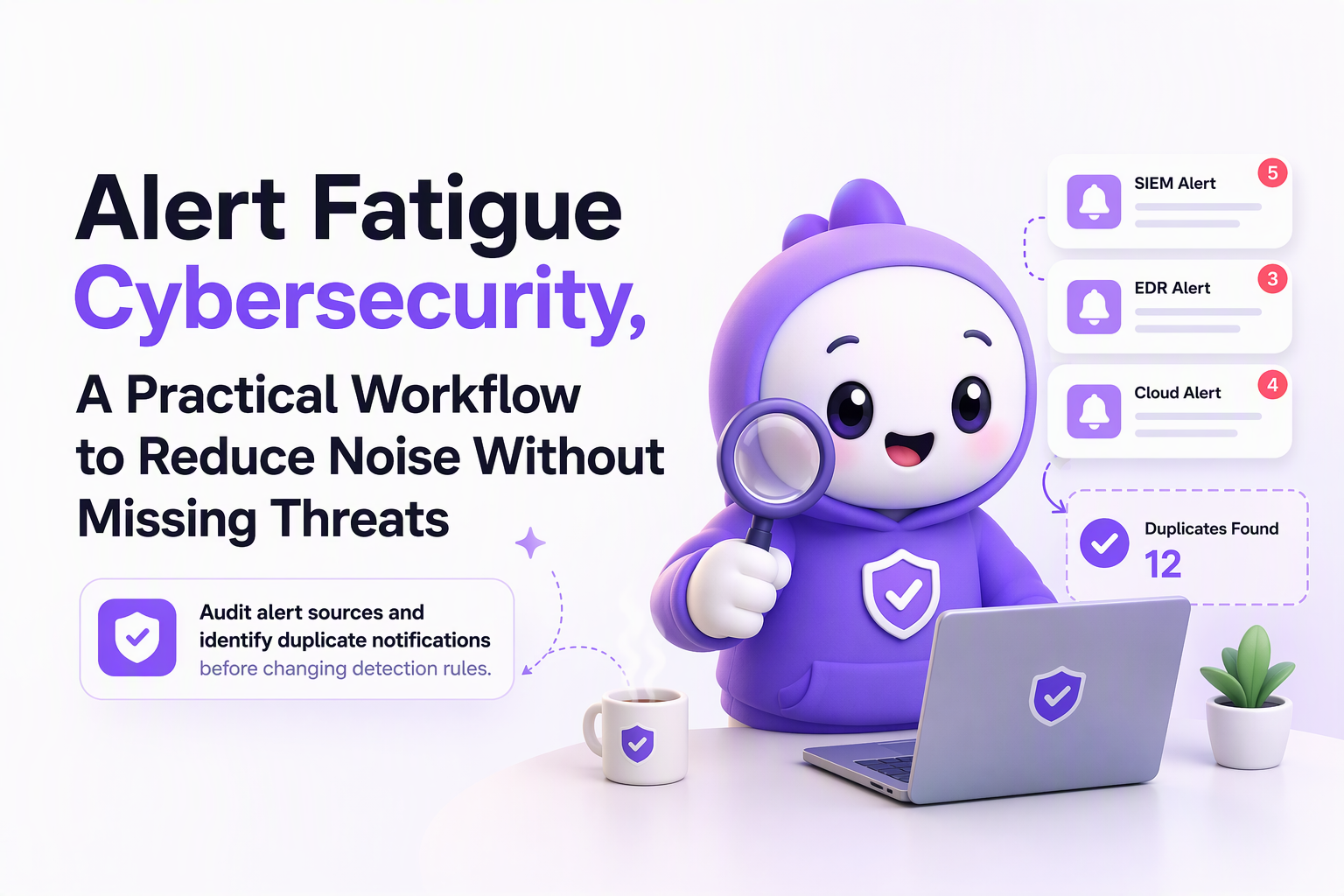
Why Alert Fatigue Cybersecurity Persists Even With Modern Security Tools
Alert fatigue cybersecurity persists when monitoring systems generate more notifications than analysts can investigate meaningfully. Security information and event management (SIEM) platforms, intrusion detection systems (IDS), endpoint detection tools, and cloud monitoring services provide valuable visibility, but collecting more telemetry does not automatically improve incident response.
Five sources of operational noise
- Duplicate events: Multiple tools report the same underlying activity, causing one suspicious process to generate several notifications.
- Poorly tuned detection rules: Broad thresholds, outdated exclusions, and rules that ignore normal business behavior repeatedly flag benign activity.
- Fragmented context: Identity, endpoint, network, and cloud signals arrive separately, requiring analysts to reconstruct incidents manually.
- Insufficient staffing: Alert queues grow when incoming investigation work exceeds available analyst capacity.
- Unclear ownership: Notifications without a named responder, acknowledgment deadline, or backup route can remain unresolved.
The consequences extend beyond inconvenience. Repeated low-value notifications compete with credible indicators of credential theft, malware execution, and data exfiltration. Analysts may acknowledge incidents later, overlook relationships between events, or become less responsive to notifications that genuinely require urgent attention.
Why additional tools do not solve the underlying problem
More detections improve security only when teams can interpret and act on their outputs. An AI classifier cannot compensate for missing asset ownership, inconsistent severity definitions, or escalation rules that send every event to the same channel. Broad suppression can be equally damaging if it removes useful evidence along with noise.
My recommended starting point is to trace a sample of noisy notifications backward to their originating rules and forward to the resulting analyst action. This review helps distinguish duplicate event generation from legitimate detections that need better context, routing, or investigation procedures.
Build an alert-source inventory
Record each source, detection owner, event type, current volume, severity mapping, destination, and known duplicate relationships. Include SIEM correlation rules, IDS signatures, endpoint detections, cloud security alerts, identity monitoring, and data-loss prevention systems. Mark sources with no accountable owner as immediate workflow risks.
The inventory should identify where multiple tools report the same activity and where an alert has no defined next action. Those findings create a defensible remediation backlog instead of an indiscriminate effort to reduce notifications.
How to Reduce Alert Fatigue With a Prioritized Remediation Workflow
A seven-day remediation sprint can establish a measurable baseline, remove safe duplicates, tune high-noise rules, and formalize escalation ownership without requiring a complete monitoring redesign.
Seven implementation phases
- Day 1, inventory sources. Owner: security operations lead. Output: a source register containing volume, rule owner, destination, and event category. Acceptance criterion: every high-volume source has an accountable owner.
- Day 2, measure the baseline. Owner: SOC analyst or operations analyst. Output: a baseline covering alert volume, actionable rate, false positives, backlog age, acknowledgment time, and response time. Acceptance criterion: metrics use documented definitions and a consistent reporting window.
- Day 3, deduplicate events. Owner: detection engineer. Output: correlation and grouping rules for repeated events with matching entities, time windows, and underlying causes. Acceptance criterion: sampled duplicates consolidate without hiding distinct incidents.
- Day 4, tune detection rules. Owner: rule owner. Output: revised thresholds, scoped exclusions, and test cases for noisy detections. Acceptance criterion: historical replay or controlled testing shows reduced benign alerts while expected malicious scenarios remain detectable.
- Day 5, enrich context. Owner: security engineering. Output: relevant identity, asset criticality, exposure, vulnerability, and threat-intelligence context attached to alerts. Acceptance criterion: analysts can identify the affected asset, account, and reason for concern from the alert record.
- Day 6, define escalation. Owner: incident-response lead. Output: severity criteria, acknowledgment targets, primary responders, backups, and escalation paths. Acceptance criterion: each priority has a documented response owner and next action.
- Day 7, automate safely. Owner: security automation lead. Output: tested routing, enrichment, and low-risk response playbooks. Acceptance criterion: test cases verify expected actions, failure handling, audit logs, and rollback procedures.
Deduplicate without erasing evidence
Group events when they share meaningful identifiers, such as an account, endpoint, process, destination, detection rule, or incident window. Retain the original events and timestamps so investigators can reconstruct the sequence. Avoid grouping solely because alerts share a severity label or broad category.
Detection-rule tuning should follow the same principle. Exclusions need a documented reason, a narrow scope, an owner, and a review date. Recheck exceptions when application behavior, infrastructure, or attacker techniques change.
Choose automation according to risk
Automate repetitive, reversible tasks first, including enrichment, routing, duplicate grouping, and ticket creation. Require human approval for disruptive actions such as disabling privileged accounts or isolating critical production systems unless an explicitly approved playbook defines the conditions and safeguards.
For practical alert management, document the signal, owner, threshold, action, and rollback condition for every automation. A workflow is ready for production when its behavior is testable, its actions are auditable, and its failure mode is understood.
How to Separate Genuine Security Threats From Low-Value Alerts
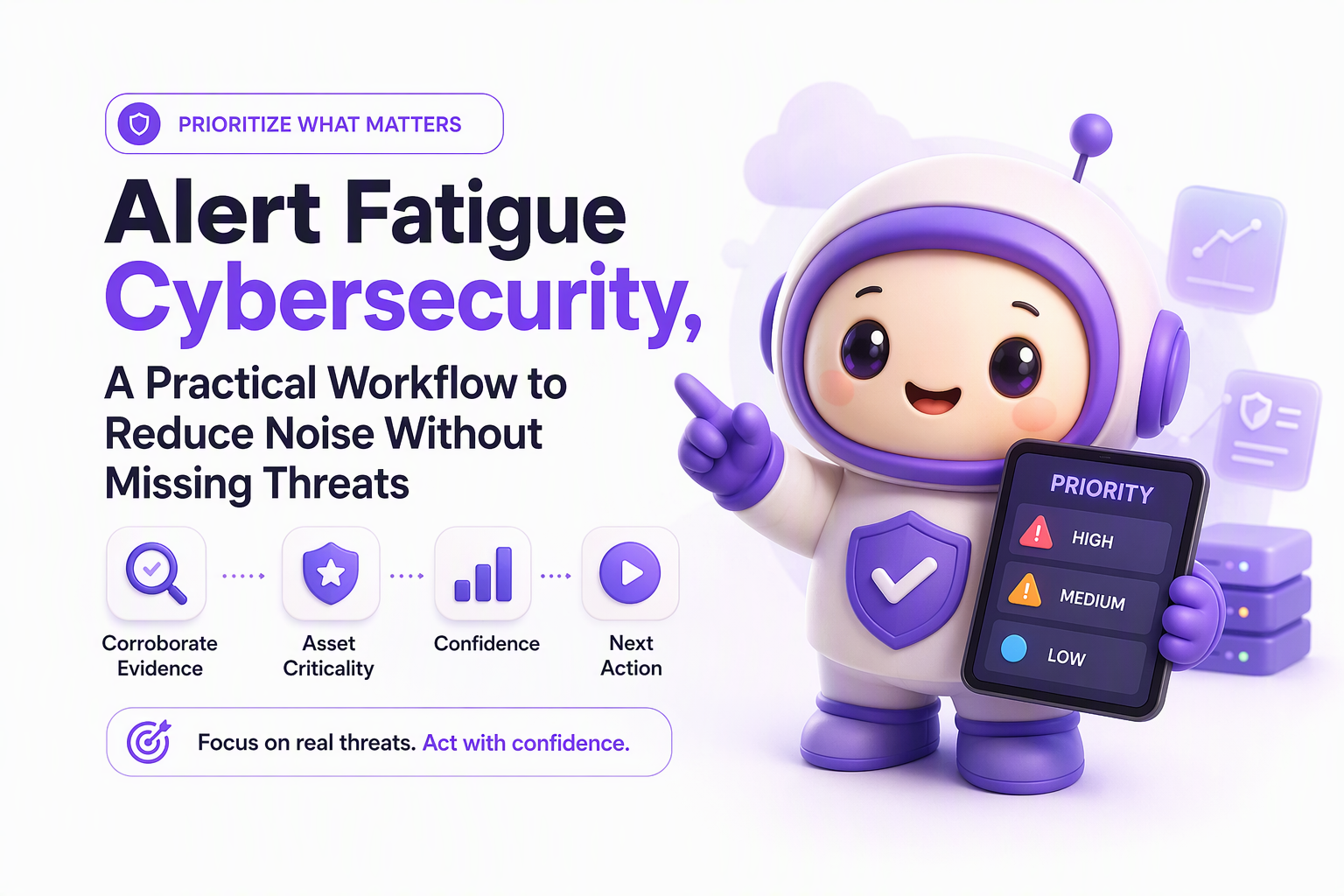
Reliable alert triage combines the initial signal with corroborating evidence, asset criticality, confidence, and a defined next action rather than treating every detection as proof of compromise.
A practical security alert triage matrix
| Alert type | Initial signal | Corroborating evidence | Priority criteria | Next action |
|---|---|---|---|---|
| Suspicious login | Unusual location, device, or authentication pattern | Impossible travel, unfamiliar device, failed-login burst, unusual MFA activity, or sensitive account access | High when privileged access or multiple independent indicators increase confidence | Validate identity activity, contact the account owner through a trusted channel, and revoke sessions if compromise is supported |
| Endpoint malware detection | Malicious file, behavior, or process alert | Process ancestry, persistence, network connections, quarantine result, or related endpoint detections | High when execution is confirmed on a critical asset or multiple indicators agree | Inspect telemetry, contain the endpoint when justified, and preserve investigation evidence |
| Unusual outbound transfer | Unexpected transfer volume or destination | Destination reputation, process identity, user activity, data classification, and transfer timing | High when sensitive data, an unusual destination, and credible exfiltration indicators coincide | Validate business purpose, inspect destination and transfer logs, and escalate suspected exfiltration |
| Sensitive-data exposure | Public access, abnormal permissions, or a data-loss prevention alert | Resource permissions, data classification, access logs, external sharing, and evidence of actual access | High when sensitive information is externally accessible or unauthorized access is confirmed | Restrict exposure where safe, preserve logs, assess access, and follow the incident-response procedure |
Use a consistent decision sequence: establish whether the signal is valid, seek independent corroboration, assess the affected asset and potential impact, assign confidence, then select the next action. An individual alert does not establish that a system has been compromised. Equally, a low-confidence signal affecting a highly critical asset may justify prompt validation rather than automatic dismissal.
Apply explicit escalation criteria
Use a small set of severity dimensions: impact, confidence, asset criticality, exposure, and time sensitivity. For example, a suspicious login to a privileged account with corroborating MFA anomalies may warrant immediate escalation, while a single unfamiliar login to a low-risk account may first require identity verification.
For a repeatable alert triage process, define acknowledgment targets and escalation ownership for each severity. An illustrative policy might require immediate paging for credible critical incidents, rapid queue review for high-priority events, and scheduled investigation for low-risk anomalies. Set actual deadlines according to staffing, risk, and contractual obligations rather than treating an example as a universal benchmark.
During triage reviews, I would examine both dismissed alerts and escalated incidents. Reviewing only successful detections hides the possibility that an exclusion or grouping rule removed evidence that would have changed the outcome.
Control false positives without weakening detection
Classify false positives by root cause, such as legitimate administrative behavior, noisy thresholds, stale asset data, or missing identity context. Fix recurring causes at the source instead of repeatedly closing the same alert manually.
Validate changes against known attack simulations, historical incidents, and relevant detection tests. Record the detection scenarios tested, expected results, actual results, and any coverage gaps. The acceptance condition is not simply fewer alerts; it is fewer unnecessary investigations with essential detection behavior preserved.
Which Metrics Prove Your Alert-Fatigue Improvements Are Working
Effective alert-fatigue measurement pairs lower notification burden with improved actionability, faster handling, manageable backlog, and evidence that detection coverage remains intact.
Six operational metrics to track
- Actionable-alert rate: Alerts that require a meaningful investigation or response divided by all reviewed alerts. Document whether the numerator includes confirmed incidents, justified investigations, or both.
- False-positive rate: Alerts confirmed benign and not requiring security action divided by all adjudicated alerts. Keep unreviewed alerts out of the denominator or report them separately.
- Alerts per analyst: Total alerts received during a defined period divided by the number of analysts assigned during that period. Also report shift length and coverage to avoid misleading comparisons.
- Backlog age: The age of unresolved alerts, ideally including the median and the oldest high-priority items. A declining average can conceal a small number of dangerously stale critical alerts.
- Mean time to acknowledge (MTTA): Average time between alert creation and the first recorded acknowledgment.
- Mean time to respond (MTTR): Define the endpoint explicitly, such as containment or remediation. The abbreviation MTTR can mean different things across organizations, so comparisons require the same definition.
Hypothetical before-and-after KPI example
The following figures are illustrative, not industry benchmarks or observed customer results. Assume a team reviews 1,000 alerts in a baseline period and 700 after deduplication and rule tuning. In the baseline, 200 alerts are actionable and 500 are confirmed false positives. After the changes, 210 alerts are actionable and 280 are confirmed false positives, with all remaining alerts classified separately.
| Metric | Before | After | Interpretation |
|---|---|---|---|
| Total alerts | 1,000 | 700 | 30% fewer notifications |
| Actionable-alert rate | 200 / 1,000 = 20% | 210 / 700 = 30% | 10 percentage-point increase |
| False-positive rate among all alerts | 500 / 1,000 = 50% | 280 / 700 = 40% | 10 percentage-point decrease using this stated denominator |
| Alerts per analyst across 5 analysts | 200 per analyst | 140 per analyst | 30% lower workload if staffing and period are comparable |
In this hypothetical example, actionable alerts increase from 200 to 210 even as total volume falls. The result is promising only if the periods are comparable, adjudication standards remain consistent, and detection coverage does not deteriorate. The false-positive calculation deliberately uses all alerts as its denominator; an operational dashboard should also report the false-positive rate among adjudicated alerts to account for unreviewed cases accurately.
Set measurement guardrails
Compare equivalent time windows and account for changes in alert-source coverage, analyst staffing, asset count, and traffic. Report severity-specific results so improvements in low-priority noise do not mask slower handling of critical events. Include reopened incidents, missed detections discovered later, and changes to detection-test pass rates.
Before declaring success, replay representative historical events or run controlled detection tests and verify that expected scenarios still trigger. Track exceptions and rule changes with owners and review dates. A lower alert count without a coverage check is a reduction in observed notifications, not proof of better security.
Teams also need to distinguish security telemetry from application reliability signals. Flash Log complements security monitoring by using AI to capture and classify application bugs automatically, including bugs users never explicitly report. That engineering visibility can help teams find product defects earlier, but it does not replace SIEM tuning, security detections, or incident response.
How to Sustain Lower Alert Volume Without Missing Critical Threats
Sustained improvement depends on recurring rule reviews, accountable ownership, documented suppression decisions, and detection-coverage checks after every meaningful change.
Use a recurring operating review
- Weekly: Review the noisiest rules, duplicate clusters, overdue critical alerts, and newly introduced false-positive patterns.
- Monthly: Compare actionable-alert rate, MTTA, response time, backlog age, and analyst workload with the baseline.
- After incidents: Check whether alert grouping, suppression, missing context, or escalation delays affected detection or response.
- After infrastructure changes: Revalidate rules affected by new assets, identity systems, cloud services, and application behavior.
Keep a change record
For each rule adjustment, document the reason, owner, expected effect, test evidence, rollback plan, and next review date. Track suppression exceptions separately so a temporary workaround does not become permanent, unexamined policy.
Review both sides of the outcome: which alerts were removed and which meaningful threats remain detectable. This discipline turns alert fatigue cybersecurity from an informal complaint about too many notifications into an operational improvement program with measurable controls.
Frequently Asked Questions
Reduce operational noise by starting with a measured baseline, tuning the highest-impact sources, and validating detection coverage after each change. For engineering teams that also need better visibility into application reliability, explore Flash Log to see how fully AI-powered bug capture and automatic classification can surface issues users never report, helping engineers deliver more efficiently. Flash Log complements rather than replaces security monitoring and incident-response tooling.
Alert Storm Explained, Causes, Risks, and How To Stop Alert Noise Fast
Learn what an alert storm is, why it happens, and a first-week framework to cut alert noise fast without missing real incidents.
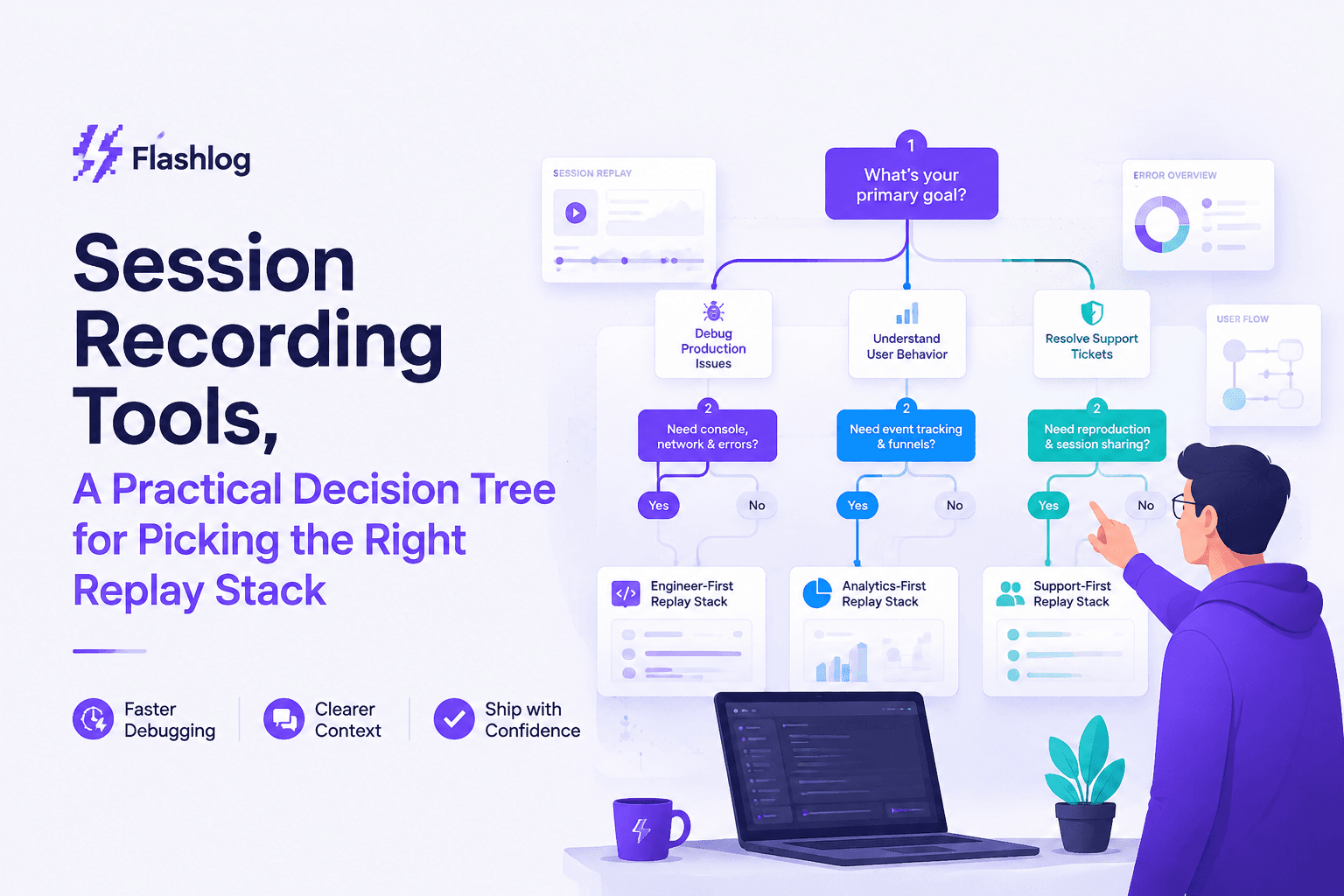
Session Recording Tools, A Practical Decision Tree for Picking the Right Replay Stack
Choose session recording tools with a 60-second decision tree and a pilot checklist for speed-to-root-cause, privacy controls, and performance impact.

How Session Replay Works, The End-to-End Pipeline From Capture to Playback
Learn how session replay works end to end: capture, serialize, transmit, store, and reconstruct, plus Android specifics, performance, and privacy.