
Adaptive Sampling for Observability, A Practical Framework to Cut Noise Without Missing Incidents
Adaptive sampling is the practice of changing telemetry collection rates based on risk and value so you reduce observability noise and cost without hiding incidents.
- Pick the right type of adaptive sampling first (telemetry vs other domains), then define sampling objectives as measurable guardrails: missed-incident risk, cost, and debugging fidelity.
- Set sampling rates using SLO risk and error budget math, then choose a strategy (head, tail, stratified) that matches your incident detection path.
- Prove sampling quality with replay, drift checks, and bias diagnostics before you roll out, and keep a kill switch for on-call.
Adaptive Sampling Means Different Things, Pick the Right One in 60 Seconds
Adaptive sampling only helps observability if it changes what logs, traces, or events you keep based on runtime signals such as error rate, latency, route, tenant, or model confidence.
The confusion is that the same phrase shows up in unrelated domains. Before you design rules, align on which “adaptive sampling” you mean, because the evaluation criteria differ: in telemetry you care about missed incidents, representativeness, and downstream debugging; in other domains you care about signal reconstruction quality.
Quick disambiguation table
| Domain using the term | What gets sampled | Adaptive signal | Success metric | Common confusion risk |
|---|---|---|---|---|
| Observability telemetry (this post) | Logs, traces, events, spans | Error/latency, endpoint, tenant tier, rarity, confidence | Lower cost and noise while preserving incident detection and debug ability | Assuming “lower volume” automatically means “lower alert fatigue” |
| Statistics / surveys | Respondents / data points | Variance, strata weights | Lower estimator variance at same budget | Borrowing formulas without mapping to operational risk |
| ML training | Training examples | Loss, uncertainty, class imbalance | Faster convergence or better accuracy | Over-optimizing “hard examples” while missing rare production failure modes |
| 3D rendering / ray tracing | Pixels / rays | Contrast, noise estimate | Visual quality per render time | Thinking “adaptive” means “smarter” without defining guardrails |
The 60-second “right one” checklist for observability
- Is your pain cost, noise, or both? Cost points to sampling; noise often also needs classification and dedupe.
- Do you detect incidents from metrics, logs, traces, or all three? Sampling the channel that drives detection increases risk.
- Do you need per-user replay? If yes, preserve high-fidelity slices (VIP tenants, checkout, auth) regardless of global rate.
- What is your unit of triage? If engineers triage “issues” not “events”, you need grouping and decisioning, not just rate control.
One practical rule: if your alerts are metric-based but your debugging is log-based, aggressive log sampling is safer than aggressive metric sampling. If your alerts are log-based, sampling becomes a reliability change and needs explicit on-call signoff.
A Practical Adaptive Sampling Framework for Logs, Traces, and Events
Adaptive sampling works in production when it is treated as a control system with explicit objectives, input signals, decision rules, and safety guardrails.
The failure mode I see most often is teams jumping straight to “sample 10%” and discovering later they sampled away the very evidence they needed. The framework below forces a measurable definition of “safe enough” before you touch rates.
Step 1: Write objectives as guardrails, not aspirations
- Detection guardrail: Which incident types must never be hidden by sampling? Examples: elevated 5xx on checkout, auth failures, latency regressions.
- Debug guardrail: What minimum context must remain to reproduce? Example: at least one full-fidelity trace per unique fingerprint per hour for P0 endpoints.
- Cost guardrail: What is the budget you must hit? Example: “keep ingest under X GB/day” or “cap trace spend under Y% of infra.”
Notice these are not vanity goals like “reduce logs”. They are constraints you can test with replay and drills.
Step 2: Choose sampling signals that correlate with incident risk
Adaptive sampling signals should be observable at decision time and should track risk. A practical menu:
- Outcome signals: HTTP status class, exception type, timeout, retry exhaustion.
- Latency signals: p95/p99 bucket of the request at completion time (tail sampling friendly).
- Rarity signals: New endpoint, new error message, unseen stack trace hash, unseen user journey step.
- Business criticality: Endpoint group (checkout, login), tenant tier, region, release ring.
- Uncertainty signals: Low-confidence classifier result, partial context, missing correlation ids.
In our experience working with teams that ship weekly, “rarity” beats “severity labels” early on because new failures are the ones engineers have not built muscle memory around.
Step 3: Encode decision rules in a small, auditable policy
A good policy is short enough that on-call can reason about it at 2 a.m. Start with deterministic rules, then add probabilistic rates.
- Always keep: Security-relevant events, auth failures, payment and order flows, and anything tied to an active incident.
- Keep by fingerprint: Keep the first N occurrences of each unique error fingerprint per time window, then downsample.
- Probabilistic baseline: Sample successes at a low stable rate to preserve baselines.
- Adaptive boost: Increase sampling when an error budget burn indicator rises, or when latency crosses a threshold.
If you are already doing event sampling, this policy becomes the explicit definition of which events deserve a higher rate and why.
Step 4: Add guardrails that prevent silent failure
- Minimum floor rates: Never drop below a small floor per service, per route group, per tenant tier.
- Incident override: A flag that forces 100% sampling for scoped services during an incident.
- Change control: Sampling policy changes go through the same review as alert changes.
- Drop accounting: Emit counters for “kept” vs “dropped” by reason so you can audit the decision path.
Without drop accounting, you cannot tell whether the “quiet week” was genuinely healthy or just aggressively sampled.
How to Set Rates Without Hiding Incidents, Use SLO Risk and Error Budget Math
Sampling rates are safest when you tie them to error budget burn and to the probability of missing a true incident signal.
Most teams already compute availability or latency SLOs; the trick is to use those same indicators to temporarily increase telemetry detail during riskier periods. This keeps steady-state cost down while preserving incident response fidelity.
Start with a detection path map
Write down the detection path for each incident type:
- Metric-first incidents: You page from RED/USE metrics, then use traces/logs to debug.
- Log-first incidents: You page from error logs, exception spikes, or message patterns.
- Trace-first incidents: You page from tail latency and distributed tracing indicators.
Only sample aggressively on channels that are not the first detector. If logs are your only detector, treat log sampling as an SLO-affecting change.
Translate error budget burn into “sampling boost” levels
Use burn rate alerts as your adaptive trigger, because they already represent “how fast you are spending reliability”. For example, define three levels:
- Normal: baseline sampling (lowest cost).
- Elevated burn: increase sampling on affected services or endpoints (2x to 10x, depending on budget).
- Incident mode: force 100% for scoped components until stability returns.
What surprised our team was how often “incident mode” only needs to apply to two or three endpoints rather than an entire service, which keeps cost spikes bounded.
Use a missed-incident probability heuristic for rare errors
For a class of events that occurs R times per hour, and a sampling probability p, the probability you see at least one is approximately 1 - (1 - p)^R.
- If an event happens once per hour, a 10% sample rate means you have a 10% chance of seeing it at all in that hour.
- If an event happens 50 times per hour, a 10% rate gives you ~99.5% chance to see at least one occurrence.
This is why uniform sampling is dangerous for low-rate, high-impact failures: it turns “rare but critical” into “often invisible”. The fix is stratification: keep rare fingerprints at much higher rates than high-volume, well-understood noise.
Head vs tail vs stratified sampling, when to use each
- Head sampling (decision at start): cheapest, but blind to outcomes like 500s or slow requests unless you already predict risk from request metadata.
- Tail sampling (decision after completion): best when you need to keep slow traces or errors; requires buffering and can be more complex.
- Stratified sampling (by class): best default for logs and events; you explicitly protect important strata (errors, rare fingerprints, critical routes) and downsample the rest.
For teams wrestling with cost math, the mechanics are similar whether you call it adaptive sampling or log sampling: rates need a measurable detection guarantee and an audit trail.
Worked example you can adapt (no vendor math required)
Assume checkout 5xx pages come from metrics, and logs are used for debugging. You can set:
- Checkout errors: keep 100% of 5xx and timeouts for /checkout routes.
- Checkout successes: sample 1% to preserve baseline and allow comparing “healthy” vs “broken”.
- Non-critical successes: sample 0.1% or less, but keep first-seen fingerprints at higher rates.
- Elevated burn: multiply affected-route sampling by 5x, and set incident override to 100% for 30 minutes after page.
The point is not the exact numbers; the point is explicit asymmetry: errors and rare signals get protection, high-volume known-good does not.
Validation and Diagnostics, Prove Sampling Quality With Replay and Drift Checks
Sampling is production-safe only after you can demonstrate that key incident signals remain detectable and that sampled data stays representative over time.
Validation is where adaptive sampling projects either earn trust or get rolled back. The tests below are designed to catch the two classic failures: bias (you kept the wrong slice) and drift (the policy stops matching reality after releases).
A verification checklist before rollout
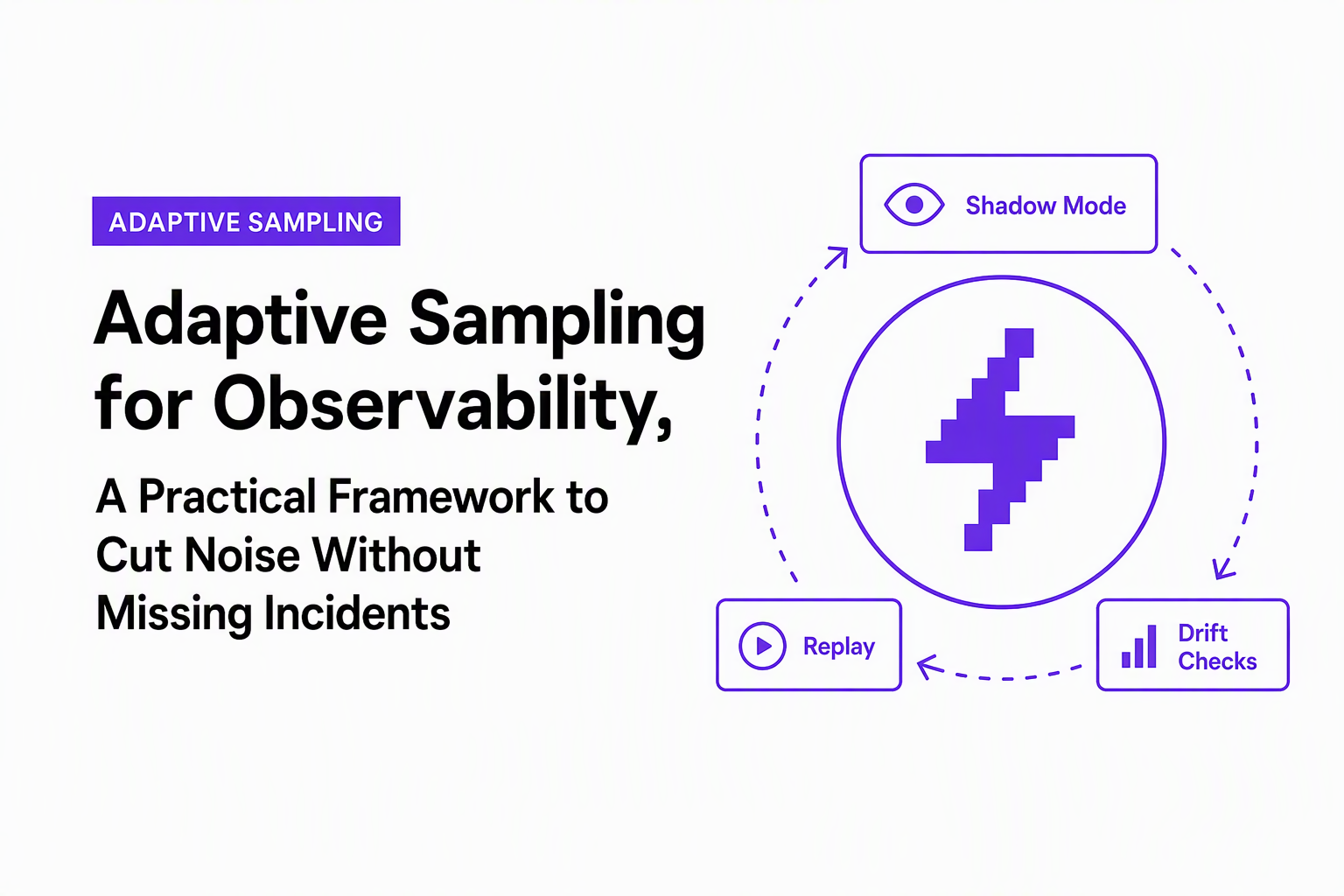
- Shadow mode: Run sampling decisions but do not drop yet; record “would have dropped” counters by service, endpoint, and status.
- Replay test: Reprocess a known-bad time window (previous incident) through the policy and confirm you would still have enough evidence to diagnose.
- Golden signals coverage: Ensure errors and latency outliers are preserved at near-100% for critical flows.
- Fingerprint retention: Verify first-N per unique fingerprint works as expected when storms happen.
- Kill switch: Confirm on-call can turn sampling off or force 100% for a scoped set in minutes.
Dashboards that make sampling auditable
- Kept vs dropped rate by service and endpoint group.
- Drop reasons (baseline, dedupe, low-confidence, non-critical success) so changes are explainable.
- Representation checks: distributions of latency buckets, status codes, and top error fingerprints in kept vs total (shadow mode makes this easy).
- Detection parity: compare incident detection times and alert counts pre vs post sampling change.
Common failure modes and how to diagnose them
- Bias toward “easy” endpoints: You kept a lot of /health and lost edge cases. Fix with endpoint allowlists and critical route groups.
- Blind spots for low-rate failures: A rare but severe bug never meets volume triggers. Fix with rarity-based protection and “first-seen” logic.
- Policy regressions after releases: New endpoints show up with wrong classification. Fix with drift monitors on “unseen fingerprint” volume.
- On-call distrust: Engineers stop believing logs. Fix with incident overrides and post-incident audits that compare what was dropped.
For teams also investing in detection of anomalies, treat sampling validation as part of the same discipline: if you cannot explain why a signal was suppressed, you cannot operate it safely.
Adaptive Sampling Algorithms You Can Implement This Week
Simple adaptive sampling algorithms outperform “one global rate” because they explicitly protect rare and high-impact failure modes.
You do not need a complex ML system to get most of the benefit; you need predictable rules, counters, and a place to tune them.
Algorithm 1: Stratified keep rules with floors (best default)
Use when: you have clear notions of critical endpoints and outcomes (errors, timeouts), and you want auditability.
// Inputs available at ingest time
route_group = classify_route(req.path)
outcome = classify_outcome(status, exception)

if route_group in CRITICAL_ROUTES and outcome in {ERROR, TIMEOUT}:
  keep(1.0)
else if outcome in {ERROR, TIMEOUT}:
  keep(0.5) // tune
else:
  keep(BASELINE_SUCCESS_RATE)

// Guardrails
apply_floor_per_service(min_rate=FLOOR)
apply_override_if_incident(service, route_group)
Selection criteria: Choose this if on-call demands explainability and you need deterministic protection for key business flows.
Algorithm 2: First-N per fingerprint per window (storm-proofing)
Use when: duplicate event storms dominate volume, but you still need at least a few exemplars for each unique failure.
fingerprint = hash(exception_type, top_stack_frames, route_group)
window = floor(timestamp / 10_minutes)
count = incr(counter[fingerprint, window])

if count <= N:
  keep(1.0)
else:
  keep(DOWNSTREAM_RATE) // e.g., 0.01

// Optional: always keep if severity is high
if route_group in CRITICAL_ROUTES and outcome == ERROR:
  keep(1.0)
Selection criteria: Choose this if your ticketing and alerts get overwhelmed by repeats. It also pairs naturally with dedupe so engineers see one evolving issue instead of hundreds of near-identical events.
Algorithm 3: Burn-rate triggered dynamic multiplier (risk-based boosting)
Use when: you have SLOs and burn-rate alerts already, and you want adaptive sampling to respond to real reliability risk.
multiplier = 1
if burn_rate(service, slo) >= 2:
  multiplier = 5
if burn_rate(service, slo) >= 10:
  multiplier = 100 // incident mode

p = clamp(base_rate(route_group, outcome) * multiplier, 0, 1)
keep(p)
After running several audits, the pattern was clear: dynamic multipliers reduce steady-state volume without teaching teams to ignore alerts, because fidelity rises exactly when the system is least trustworthy.
Where “adaptive sampling” stops and “noise control” begins
Adaptive sampling reduces volume, but it does not inherently decide which failures are expected, duplicated, or low-confidence. Many teams combine sampling with a decision layer that filters known harmless outcomes, groups duplicates, and routes only actionable issues. That division of labor keeps sampling focused on cost and representativeness rather than on triage semantics.
Operational Checklist, Roll Out Adaptive Sampling Safely in Production
A safe rollout for adaptive sampling is staged, reversible, and measured against detection parity and on-call acceptance criteria.
This checklist is optimized for teams that cannot afford a “we will find out in the next incident” learning cycle.
Stage 0: Prepare the ground (1 to 3 days)
- Inventory detectors: enumerate which alerts rely on which telemetry channel.
- Tag criticality: define CRITICAL_ROUTES, tenant tiers, and security-relevant event classes.
- Define the audit counters: kept/dropped by reason, by service, by route group.
Stage 1: Shadow mode (at least one deploy cycle)
- Run the policy without dropping; store drop decisions as metadata.
- Compare distributions (status codes, latency buckets, fingerprints) between kept and total.
- Set floors wherever you see strata going to near-zero.
Stage 2: Limited enforcement (one service or one route group)
- Enforce sampling for non-critical successes first, keep all errors and rare fingerprints.
- Run a game day: simulate an error spike and confirm the incident override raises fidelity.
- On-call acceptance criteria: engineers can still answer “what changed”, “who is affected”, “where is it failing” within existing time bounds.
Stage 3: Expand coverage with a rollback plan
- Expand by route groups, not by entire organizations at once.
- Keep a one-click rollback to baseline sampling, and document when to use it.
- Post-incident sampling audit: after every P0/P1, review what was dropped and whether it would have changed diagnosis time.
Stage 4: Continuous tuning (monthly cadence)
- Update critical route lists as product surface area changes.
- Watch drift signals: growth in unseen fingerprints, new endpoints with high drop rates.
- Retune rates only with before/after dashboards and a written hypothesis.
If you also run a formal alert triage process, treat sampling policy as part of the same change management: both affect what reaches humans.
| Goal | Recommended sampling pattern | Primary guardrail | Proof artifact |
|---|---|---|---|
| Cut ingest cost on high-volume successes | Low baseline rate + floors | Baseline representativeness | Kept vs total distribution in shadow mode |
| Stop duplicate storm noise | First-N per fingerprint per window | At least N exemplars per unique failure | Fingerprint retention dashboard |
| Protect incident response fidelity | Burn-rate multipliers + incident override | Detection parity during incidents | Pre/post incident drill or replay test |
| Preserve rare but critical failures | Rarity-based strata, keep first-seen | Missed-incident probability bound | Unseen fingerprint alert and audit |
FAQ about adaptive sampling
If you implement the rollout checklist above, consider adding Flash Log as a backstop for what sampling and rate controls do not solve: Flash Log automatically captures and classifies production bugs even when users never report them, then filters expected failures and duplicates so engineers see fewer noisy interruptions and more actionable issues.
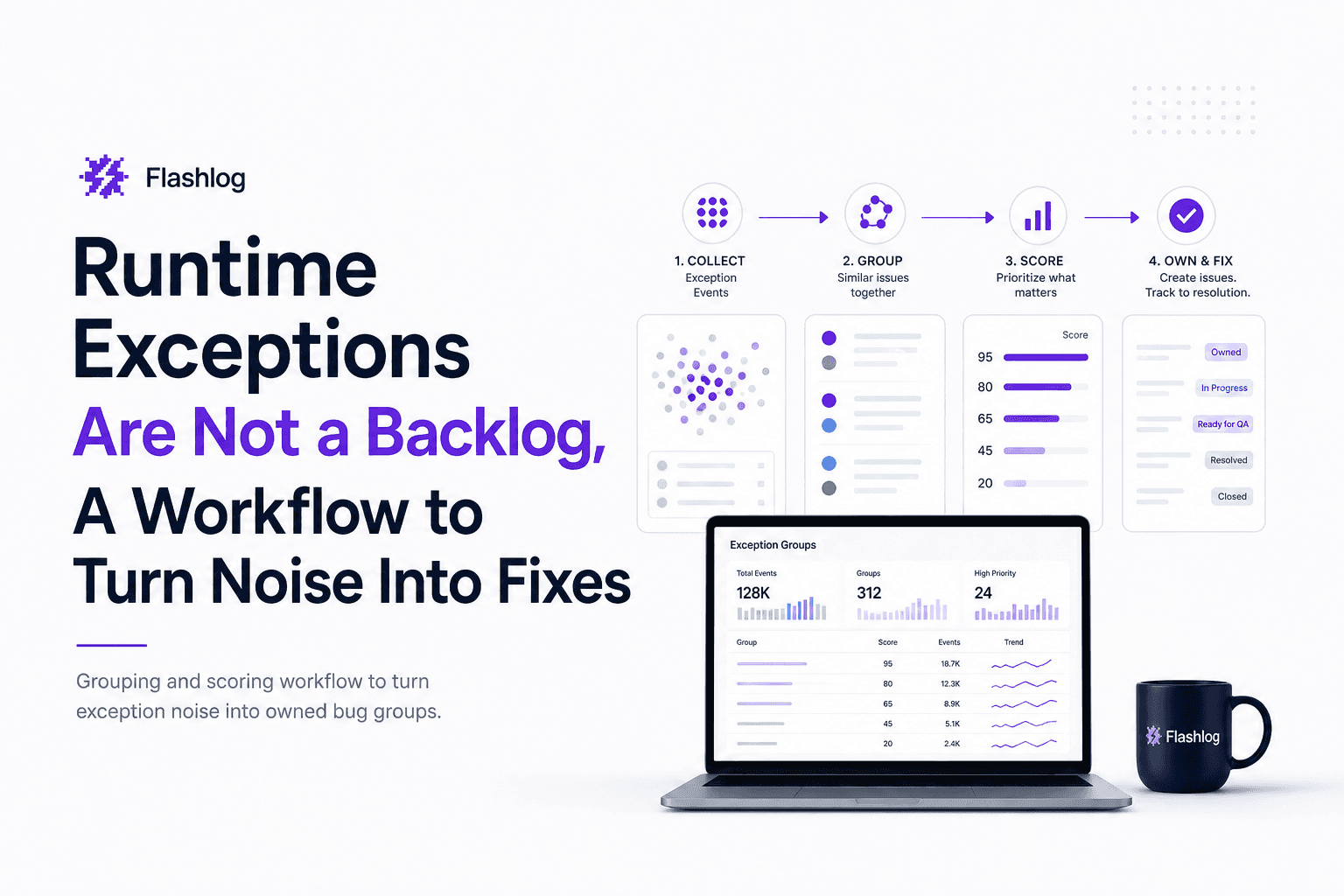
Runtime Exceptions Are Not a Backlog, A Workflow to Turn Noise Into Fixes
Learn a practical workflow to triage runtime exceptions into actionable bug groups using fingerprinting, impact scoring, and routing rules.
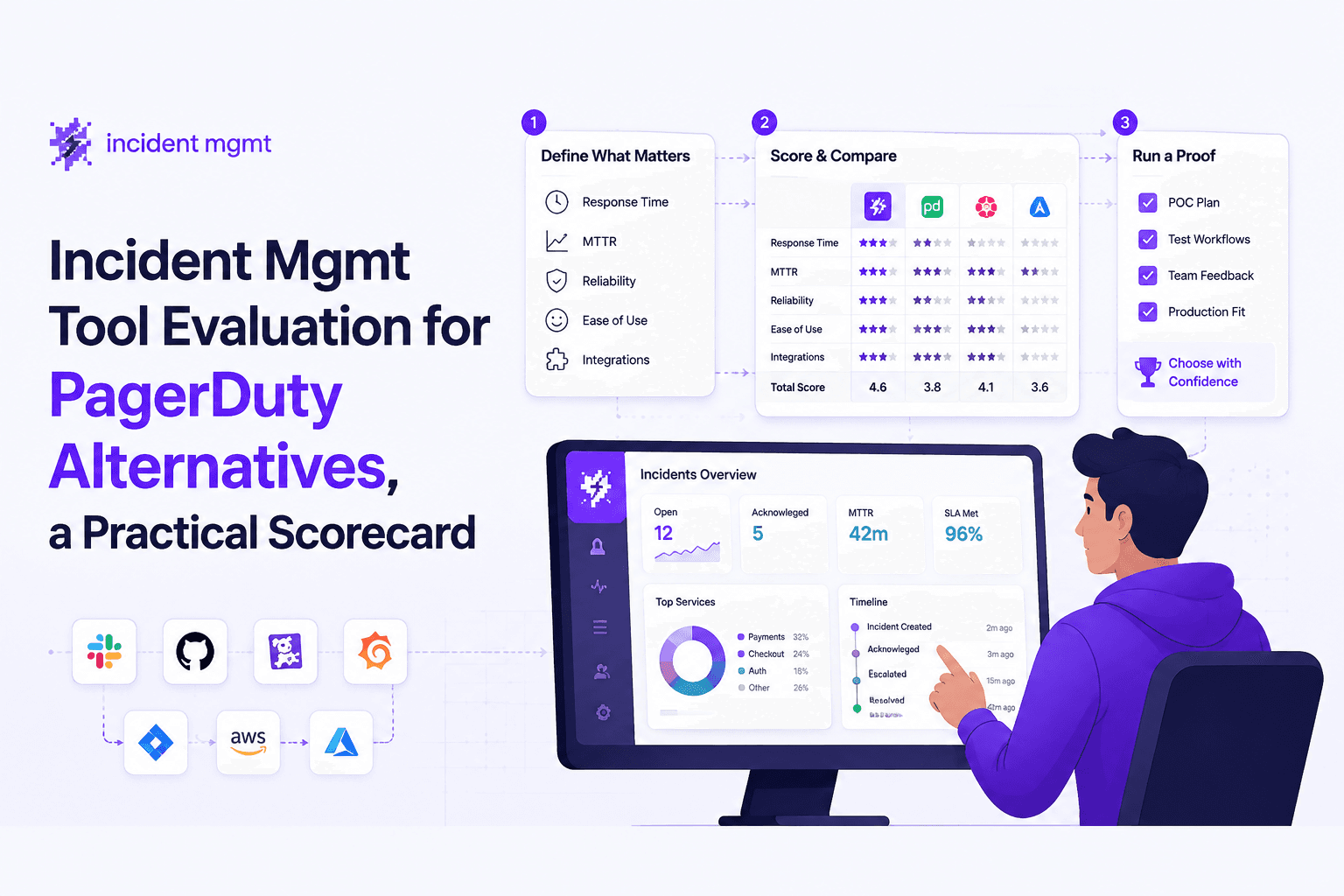
Incident Mgmt Tool Evaluation for PagerDuty Alternatives, a Practical Scorecard
Use this incident mgmt scorecard to compare PagerDuty alternatives, cut alert noise, validate workflows, and reduce MTTR with proof questions.

Anomaly Detection With Machine Learning, A Practical Playbook For Reducing Alert Noise
Anomaly detection with machine learning without alert noise: choose setup, build features, calibrate thresholds, evaluate incidents, ship safely.