
AI Noise Reduction Explained, A Practical Framework for Better Signal Quality
AI noise reduction is the practice of using machine-learned models to separate unwanted interference from a target signal, and it works best when you measure both “cleaner output” and downstream correctness, not just how quiet something sounds or looks.
- Evaluate ai noise reduction with task-based metrics (intelligibility, accuracy, false alarms), not only subjective “sounds cleaner” checks.
- Most failures come from trade-offs: artifacts, lost detail, latency, and privacy constraints that were not tested early.
- In engineering workflows, noise reduction often means fewer interruptions by filtering duplicates, expected failures, and low-confidence signals before they become tickets.
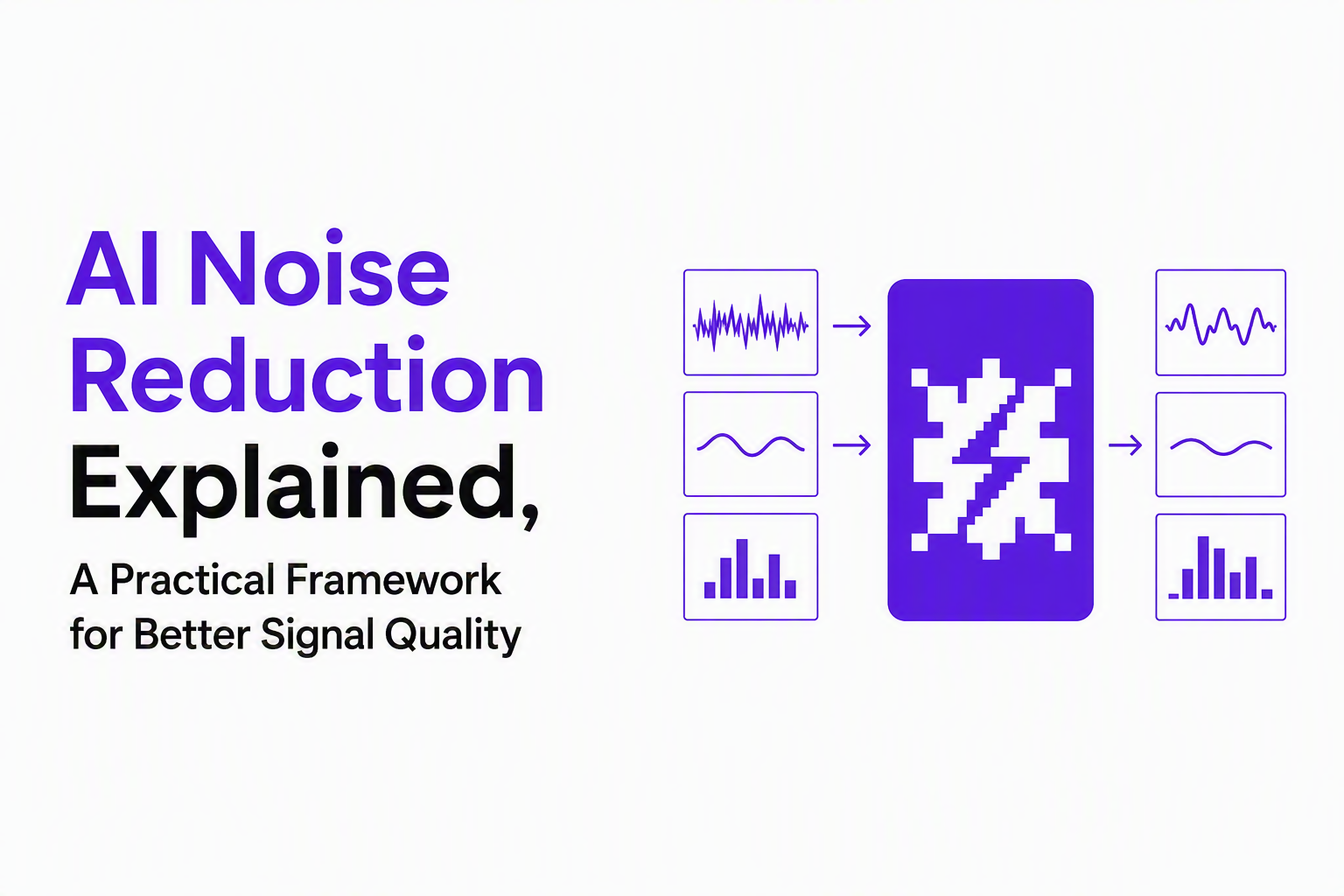
How AI Noise Reduction Works Across Audio, Video, and Data Workflows
AI noise reduction works by estimating what portion of an input is “signal” versus “noise” and then suppressing the noise component while trying to preserve the structure that matters for a human or downstream system.
Start by separating “reduction” from adjacent techniques
Teams often mix up terms, which leads to mis-scoped expectations. Use this quick differentiation to align stakeholders:
- Noise reduction: suppresses unwanted components while keeping the target signal (speech, image detail, event pattern).
- Noise cancellation: uses a reference or anti-phase technique (common in acoustics) to cancel predictable noise; not always “AI”.
- Enhancement: boosts desired features (sharpening, contrast, voice presence) and may amplify noise if misapplied.
- Removal: deletes portions (silence trimming, background removal). Effective but can destroy context.
- Denoising as pre-processing: reduces noise to improve another task (ASR accuracy, anomaly scoring stability, bug triage quality).
The common pattern behind modern denoisers
Across media and data pipelines, most AI denoisers follow one of two patterns:
- Learned mapping: a model learns to transform a noisy input into a clean estimate based on training pairs (noisy, clean) or synthetic noise injection.
- Probabilistic separation: the model estimates a mask or probability for each time-frequency bin (audio), pixel/patch (video), or event feature (logs) being noise, then attenuates accordingly.
In practice, “good” ai noise reduction is less about removing everything unwanted and more about preserving the signal components that your decision depends on: consonants in speech, edges in video, or the contextual fields that explain an incident.
Where it breaks when you move between domains
Audio, video, and engineering events differ in what counts as unacceptable damage:
- Audio: artifacts like musical noise can reduce intelligibility even if the output sounds quieter.
- Video: temporal flicker can be worse than grain, especially for motion.
- Engineering data: over-filtering can hide real incidents, while under-filtering creates alert fatigue.
A Practical Framework for Measuring AI Noise Reduction Quality
Measuring ai noise reduction quality requires a two-layer scorecard: (1) signal quality and artifacts, and (2) impact on the actual task you care about, such as comprehension, detection, or triage accuracy.
Step 1: Define the “job” the signal must do
Before you test any model, write a one-line job statement and a failure statement:
- Job: “Speech must be transcribed correctly enough to route support calls.”
- Failure: “Denoiser distorts names and order numbers.”
This prevents the classic trap: optimizing for “cleaner” while degrading the thing that matters.
Step 2: Use a balanced metric set (not a single score)
A practical scorecard typically includes:
- Perceptual quality: human rating rubric, plus domain tools when available (for audio, common toolkits exist; for video, check for temporal artifacts).
- Task accuracy: ASR word error rate shifts, object detection precision/recall shifts, or incident triage precision/recall shifts.
- Artifact audit: checklist of known failure modes (musical noise, oversmoothing, flicker, “hallucinated” edges, missing stack frames).
- Latency and throughput: does it meet real-time or batch constraints, and does it degrade under load?
When we tested denoising for speech-to-text in a busy environment, the surprising outcome was that the “best sounding” setting caused the most routing mistakes because it clipped short consonants that the ASR relied on.
Step 3: Run A/B tests on representative noise, not idealized samples
Build an evaluation set that mirrors production, including:
- Different noise types (steady hum vs intermittent bursts; packet loss vs duplication storms)
- Different signal levels (quiet speakers; low-light video; sparse logs)
- Edge cases (multiple speakers; fast motion; cascading retries)
For engineering workflows, include periods with incident storms where duplicates and expected failures spike. That is where ai noise reduction either pays off or creates blind spots.
Step 4: Add safety checks for over-filtering
Over-filtering is the expensive failure mode because it creates false calm. Add explicit “must not miss” tests:
- Canary signals: known critical patterns that must always pass through.
- Confidence gating: if the model is unsure, route to review instead of dropping.
- Drift checks: periodic re-scoring on recent samples to detect changing noise patterns.
If you already track false positives, pair it with a “false negatives on critical class” review so quiet dashboards do not become a liability.
How to Choose AI Noise Reduction Tools for Real-World Constraints
Choosing ai noise reduction tools is mainly a workflow and constraint-matching exercise, because the “best” model on a demo often fails on latency, privacy, integration, or controllability in production.
Selection checklist you can use in a procurement doc
- Where it runs: on-device, on-prem, or cloud; offline capability if needed.
- Control surface: can you tune aggressiveness, thresholds, or class-based rules?
- Explainability: can the system tell you why something was suppressed or kept?
- Integration cost: SDK availability, batch APIs, streaming support, and observability hooks.
- Failure behavior: what happens when confidence is low, inputs are corrupted, or rate limits hit?
- Security and privacy: data retention, access controls, and whether raw content leaves your environment.
Free vs paid is usually about limits, not “better AI”
In our experience working with teams rolling denoisers into daily operations, the paid decision was driven by predictable constraints: maximum file length, batch throughput, API reliability, and the ability to lock configurations so quality does not shift between users and machines.
Questions that prevent “demo wins, production losses”
- Does the tool provide a measurable before/after report tied to your task metric?
- Can you replay the same input deterministically for audits and regressions?
- Can you route “uncertain” outputs to review instead of silently suppressing?
- Is there a clear rollback path if artifacts become unacceptable?
Using AI Noise Reduction to Improve Engineering Feedback Loops
AI noise reduction in engineering often means reducing noisy interruptions, not deleting logs, by filtering expected failures, deduplicating event storms, and holding back low-confidence signals until they are actionable.
A 4-step noise gate for bug and incident inputs
- Capture broadly: collect runtime errors, failed requests, and broken user journeys, including cases users never report.
- Apply deterministic rules first: ignore known harmless endpoints, statuses, and flows so you do not waste model capacity on obvious noise.
- Classify with confidence: label what looks like a real bug vs expected behavior, and use a confidence threshold to decide whether to create work.
- Group duplicates into one evolving issue: fingerprint repeated failures so one root cause does not become one hundred alerts.
What to measure so “cleaner” really means better
Track operational metrics that map to engineering outcomes:
- Issue precision: share of created tickets that engineers agree were actionable.
- Duplicate compression ratio: how many raw events become one grouped issue thread.
- Time-to-triage: whether engineers can decide faster with less scrolling and context switching.
- Miss rate audits: sampled review of ignored or low-confidence events to ensure real incidents are not being suppressed.
After running several noise audits on alert streams, the pattern was clear: duplicates create the perception of urgency while expected business errors create the volume, so you need both grouping and classification to get durable reduction.
How a “noise reduced” issue should look
A clean output should carry a decision and a reason, not just fewer fields. For example, a structured payload might include a classification (real bug, duplicate, ignored, low confidence), a fingerprint for grouping, and an explanation of impact so routing to Jira, Linear, or Slack stays trustworthy. If you are building this yourself, a log analyzer workflow plus replayable classification tests will help you validate changes before they hit the on-call rotation.
| Evaluation area | What to test | Pass criteria (example) | Common failure mode |
|---|---|---|---|
| Signal quality | Human rubric + artifact checklist | Artifacts rare and non-disruptive | Oversmoothing, musical noise, flicker |
| Task impact | Before/after task metric (ASR, detection, triage) | No material accuracy regression | “Cleaner” output reduces correctness |
| Safety | Critical-class miss audit + confidence gating | Critical signals always routed | Silent suppression of real incidents |
| Operations | Latency, throughput, determinism | Meets real-time or batch SLAs | Slowdown under load, non-repeatable outputs |
| Governance | Privacy, retention, access control | Meets security requirements | Data leaves environment unexpectedly |
FAQ
If your engineering pain is not noisy audio or video but noisy bug signals, Flash Log is one option to apply ai noise reduction principles to production feedback loops by automatically capturing issues, classifying what is likely actionable, and keeping duplicates and expected failures from turning into interruptions.

Stack Trace Explained, How To Read It And What To Collect When It’s Not Enough
Learn what a stack trace is, how to read it, and what context to collect when a stack trace isn’t enough to fix production bugs.
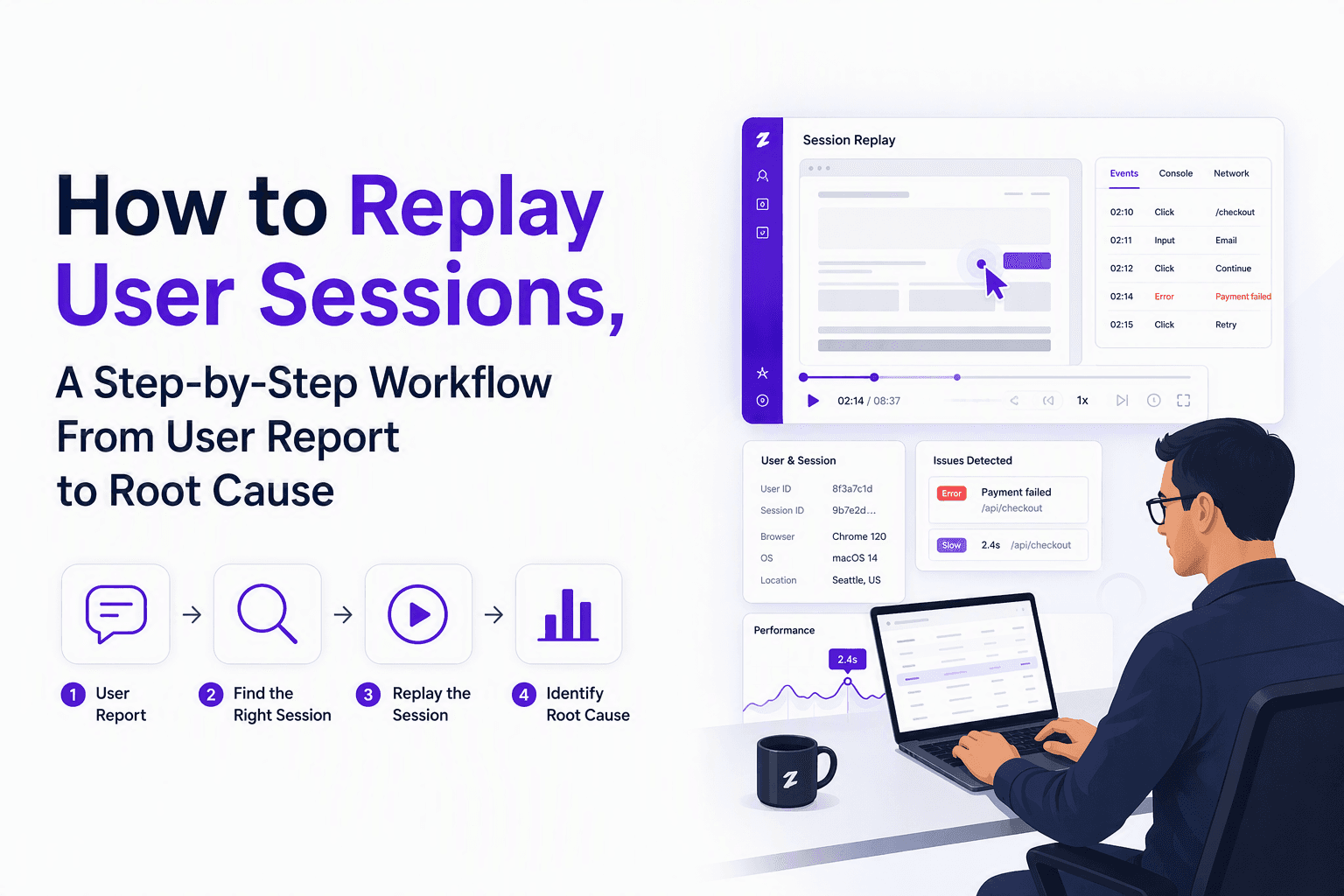
How to Replay User Sessions, A Step-by-Step Workflow From User Report to Root Cause
Learn how to replay user sessions with a practical workflow: find the right session, review signals, document findings, and share safely.
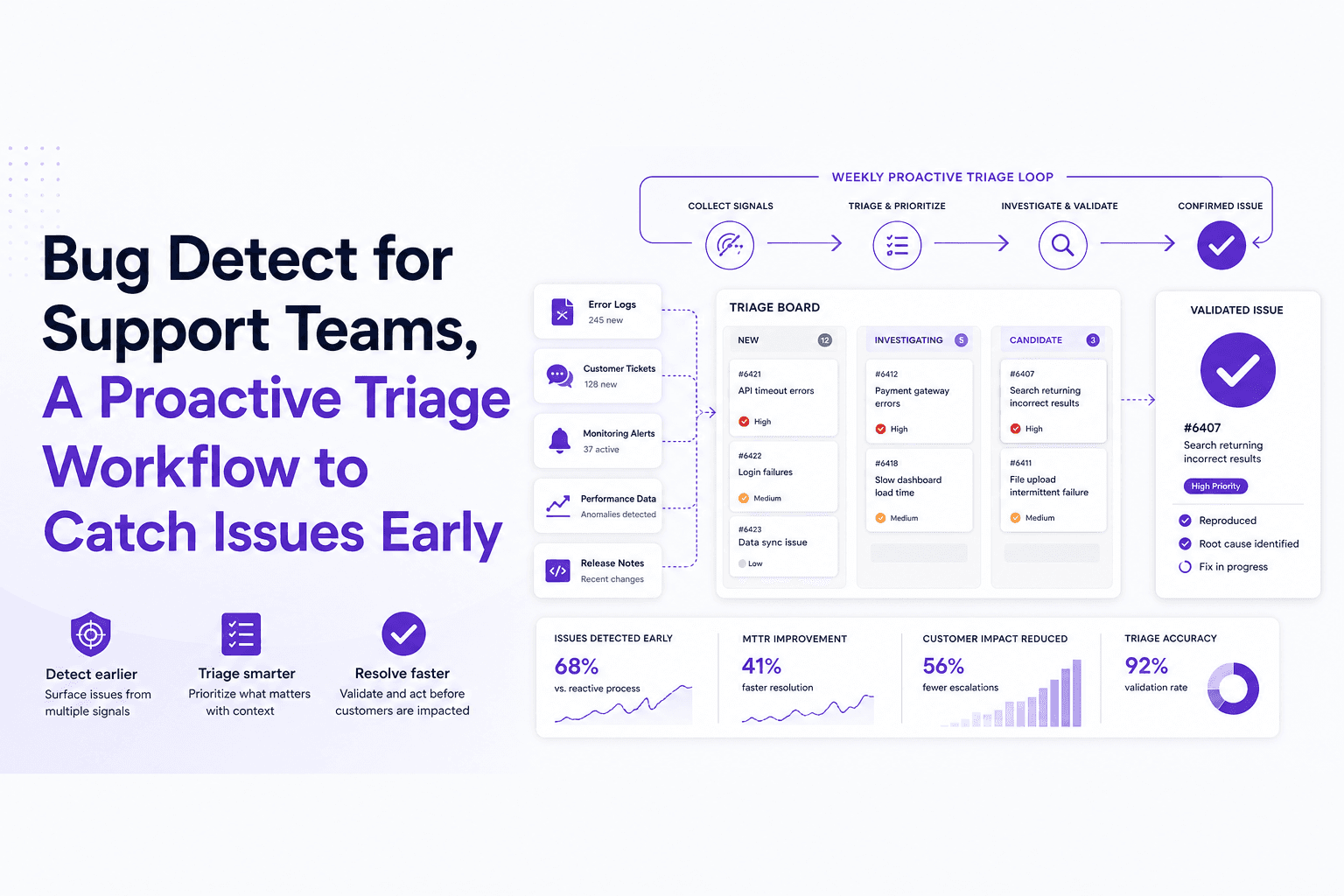
Bug Detect for Support Teams, A Proactive Triage Workflow to Catch Issues Early
Learn a practical bug detect workflow for support teams: weekly triage, evidence packs, automation, and KPIs to reduce noise and MTTR.