
Incident Alerting That Stays Actionable, An AI Noise Reduction Framework
Incident alerting stays actionable when you define a noise budget up front and then apply layered AI noise-reduction guardrails so only high-signal pages reach on-call.
- Set acceptance criteria first: paging policy, SLO-based triggers, and a measurable noise budget (alerts per service per day and pages per on-call shift).
- Reduce noise in four layers in order: routing, deduping, correlation, and suppression with clear ownership and testable rules.
- Validate aggressively: backtest against incident timelines, run shadow paging, and track precision and recall so noise reduction does not create blind spots.
Define actionable incident alerting with a noise budget
Actionable incident alerting is alerting where every page has a defined owner, a documented response, and a measurable expected value versus a known noise budget.
Start with acceptance criteria you can enforce
Instead of arguing about whether an alert is “noisy,” define what “acceptable” means for the organization and for each service. A practical acceptance checklist we use looks like this:
- Owner: one team owns it, with a clear on-call rotation and an escalation target.
- Action: the page maps to a runbook step that can be performed immediately (rollback, failover, feature flag off, capacity increase, or known workaround).
- User impact: it represents user-visible degradation or imminent risk of it, not just an internal exception counter.
- Time sensitivity: response in minutes matters; otherwise route to ticket or report.
- Expected volume: alert and page rates stay within the agreed noise budget.
Turn “alert fatigue” into targets that can be reviewed
A noise budget is a set of explicit limits that make trade-offs visible. If you already manage error budgets for SLOs, treat noise budgets similarly: you can “spend” pages when uncertainty is high, but you do not want to live in deficit.
- Alert volume target (per service): maximum alert notifications per day (for non-paging channels like Slack).
- Paging target (per rotation): maximum pages per on-call shift that require an acknowledgment.
- False page target: a definition of what constitutes “non-actionable” (for example: resolved before acknowledgment, known business error, duplicate within a short window).
When we introduced a noise budget in our own ops reviews, the discussion shifted from “who is annoyed” to “which signals are worth spending pages on this week,” and it became much easier to deprecate legacy alerts.
Anchor paging to SLOs and policy, not raw error rates
For most web services, paging on a raw 5xx count creates alert storms during deploys, client retries, or partial dependency failures. A more stable approach is:
- SLO-driven pages: page on burn rate or a fast-moving SLI breach rather than a single metric spike. If you use SRE-style burn rates, link the page to the SLO and the time window used.
- Policy separation: one set of policies for paging, another for ticketing, and a third for “FYI” notifications.
For a deeper framework on routing and escalation boundaries, see alert management and how it ties to ownership.
Instrument first, then reduce noise in four layers
Incident alerting becomes manageable under load when you reduce noise in a fixed sequence that prevents downstream systems from amplifying upstream mess.
Layer 1 Routing: prevent “wrong person” pages
Routing is where you prevent broad blast radius notifications. Make routing deterministic and auditable:
- Route by service boundary: page the owning team, not “platform” by default.
- Route by environment: production pages, staging tickets, dev-only dashboards.
- Route by impact tier: user-facing vs internal tooling.
Routing problems look like noise but are actually ownership bugs. If you are still iterating on who should get paged and when, establish an escalation policy matrix before tuning thresholds.
Layer 2 Dedup: collapse repeats into one evolving problem
Deduplication prevents “same incident, many alerts” by grouping events into a single incident or alert fingerprint. Implementation checklist:
- Pick a fingerprint: use stable fields (service, endpoint, error class, dependency, region) rather than volatile text.
- Choose a dedup window: long enough to catch retry storms, short enough to allow distinct incidents (often minutes for paging, hours for ticketing).
- Track occurrence count: store how many repeats happened while deduped so responders can see scale without extra pages.
In our experience, the biggest dedup failure mode is putting raw exception messages into the fingerprint: a single code path can generate thousands of “unique” alerts due to changing IDs.
Layer 3 Correlation: one page for the root cause chain
Correlation reduces noise by turning multiple symptoms into one actionable incident. A workable approach is correlation by dependency graph and timing:
- Dependency-first: if Service A errors spike immediately after Service B latency spikes, group A under B as a likely downstream symptom.
- Golden signal alignment: correlate across latency, traffic, errors, and saturation to see whether an error spike is isolated or part of a broader event.
- Change awareness: correlate with deploy markers or config flips; many “incidents” are change-induced and benefit from quick rollback paths.
Layer 4 Suppression: silence known expected failures
Suppression is where you mute what you already know is not actionable, without deleting observability. Treat suppression as policy with tests:
- Business-expected outcomes: declines, validation failures, permission denials should not wake on-call by default.
- Known harmless endpoints: health checks, optional assets, and third-party callbacks often produce misleading errors.
- Planned maintenance: suppress by time window and scope, and require a post-window audit to ensure alerts return.
If you regularly experience a burst of pages from one failure mode, it is usually an alert storm pattern: repeats plus weak dedup plus missing suppression for expected conditions.
AI noise reduction patterns that work in production incident alerting
AI noise reduction improves incident alerting when it is used as a decision layer that clusters similar events, learns seasonality, and gates low-confidence signals instead of blindly paging on every anomaly.
Pattern 1 Similarity clustering for “same bug, many shapes”
Traditional dedup requires you to predefine the fingerprint fields; clustering helps when the same underlying failure appears with small variations. Implementation choices that hold up operationally:
- Normalize inputs: strip IDs, timestamps, and user-specific tokens before comparing events.
- Cluster on context: include endpoint, exception class, dependency name, and the step in the user journey, not just the message.
- Human-auditable explanation: store “why these were grouped” so responders can trust the cluster.
What surprised our team was how often clustering found “hidden duplicates” across services: the same downstream dependency timeout surfaced as distinct alerts in each caller, and grouping by dependency reduced the number of unique pages without reducing detection.
Pattern 2 Dynamic thresholds tied to traffic and deployment cycles
Static thresholds fail in high-volume systems because normal changes in traffic create abnormal-looking metric swings. Dynamic thresholding is useful when you can define guardrails:
- Scale with volume: alert on error rate (or errors per request) rather than error count.
- Use multiple windows: combine a fast window (minutes) and slow window (hours) to detect sharp spikes and sustained degradation.
- Deploy-aware thresholds: treat the first minutes after a deploy differently, but require an explicit expiration so “temporary” rules do not become permanent blind spots.
Pattern 3 Seasonality-aware baselines for known rhythms
Seasonality helps when your baseline is not flat: batch jobs, business-hour peaks, and weekly reporting cycles. Practical guardrails:
- Pin to calendars you control: known jobs and scheduled events should be annotations, not “mystery baselines.”
- Constrain the model: cap how much baseline can drift week to week so you still catch slow regressions.
- Fallback triggers: always keep a simple “hard” safety threshold for catastrophic failure.
Pattern 4 Confidence gating for low-signal bug events
Not every captured error is an incident, and AI can help hold back low-confidence signals until you have more context. An operational way to use gating:
- Confidence thresholds per channel: high confidence can page, medium confidence can create a ticket, low confidence can be batched into a daily review.
- Escalate on repetition: a low-confidence event that repeats across many users can be promoted automatically.
- Require explainability: if the system cannot explain why it thinks something is incident-worthy, it should not be allowed to page.
Don’t miss real incidents, validation and guardrails
Noise reduction is only safe when you validate it against historical incidents and continuously measure precision and recall for your incident alerting decisions.
Backtest every rule and model change
Before enabling a new suppression rule, dedup key, or AI classifier threshold, replay it against a window of historical data that includes known incidents. Your backtest should answer two questions:
- Would we still have paged for each real incident? If not, what alternative signal should have paged?
- How many pages would have been prevented? If the reduction is small, the operational risk may not be worth it.
Keep a simple “golden set” of past incident timelines and link each to the signals that originally detected it.
Run shadow paging before changing production behavior
Shadow paging means you compute the new alerting decision but do not notify humans. Instead, log what would have happened and review it weekly. A lightweight shadow paging template:
- Duration: one or two on-call cycles for the affected service.
- Review: compare “would page” vs “did page” and label outcomes.
- Promotion criteria: only enable real paging once the team agrees on the miss and noise trade-offs.
Measure alert quality with precision and recall, not vibes
You do not need perfect statistics to get value, but you do need consistent definitions:
- True positive page: a page that led to concrete incident response work for real user impact.
- False positive page: a page with no action, or action that was “ignore and sleep.”
- Miss: a user-impacting incident discovered by users, support, or dashboards before paging.
From those labels, you can track precision (share of pages that were true positives) and recall (share of real incidents that did page). After running several audits, the pattern was clear: most “misses” came from over-broad suppression rules, not from dynamic thresholds, so we started requiring an owner and an expiration date for every suppression.
Postmortem audits should include “alerting diff”
Every postmortem should answer: “Which alerts fired, which should have fired, and which should never fire again?” If you already have an incident management process, add an alerting diff checklist item so improvements become a routine output, not a side quest.
Operate and improve weekly, metrics, reviews, and runbooks
Weekly alerting operations keeps incident alerting actionable by tying every tuning change to on-call quality metrics, not just fewer notifications.
Use a weekly tuning loop with clear inputs and outputs
A simple loop that works across teams:
- Inputs: last week’s pages, top 10 noisy alerts, top 10 suppressed patterns, and the incidents that mattered.
- Decisions: keep, tune, suppress, or reclassify each alert; assign an owner for any rule change.
- Outputs: updated runbook links, updated fingerprints, new suppression rules with expirations, and a backtest plan.
Track on-call health alongside MTTA and MTTR
MTTA and MTTR matter, but they will not tell you when alerting is eroding trust. Add a few operational metrics you can measure from paging logs and reviews:
- Pages per shift: compare to your noise budget.
- Repeat pages: how many pages were duplicates of an already-known issue.
- Ack without action rate: pages acknowledged but closed with no remediation.
- Runbook coverage: percentage of paging alerts that link to a maintained runbook.
Write runbooks for decisions, not dashboards
Runbooks should tell an on-call engineer what to decide and do in the first 5 to 10 minutes: confirm impact, stop the bleeding, and escalate correctly. If a runbook is mostly screenshots of graphs, it tends to age poorly.
Where Flash Log fits for making recurring incidents fixable
Incident alerting often fails at the handoff between “we saw errors” and “we can reproduce and fix the root cause.” Tools like Flash Log add value when you want automatic AI bug capture even when users never file a report, plus classification and grouping so repeated failures become one prioritized issue rather than endless noisy tickets.
| Noise-reduction layer | Primary goal | Best for | Common failure mode | How to validate safely |
|---|---|---|---|---|
| Routing | Notify the right owner | Multi-team systems | Pages go to broad channels | Review misrouted pages weekly |
| Dedup | Collapse repeats | Retry storms, recurring bugs | Fingerprint too specific | Count duplicates per incident |
| Correlation | Group symptoms to root cause | Dependency failures | Over-grouping hides distinct issues | Compare grouped incidents to postmortems |
| Suppression | Mute expected outcomes | Business errors, known endpoints | Rules become permanent blinders | Require expiry and backtests |
| AI clustering and thresholds | Adapt to variation and scale | High-volume noisy telemetry | Opaque grouping or drifting baselines | Shadow paging plus precision/recall labels |
FAQ
If you want to reduce paging noise while making recurring failures easier to fix, pilot Flash Log on one service or one on-call rotation: pair tighter incident alerting rules with automatic AI bug capture and classification so duplicated production failures turn into a single actionable issue your engineers can prioritize and resolve.
Alert Triage for On-Call Teams, A Practical Framework For Reducing Noise And Escalations
Learn alert triage methods for on-call teams to reduce noise, improve escalation decisions, and build faster incident response workflows.
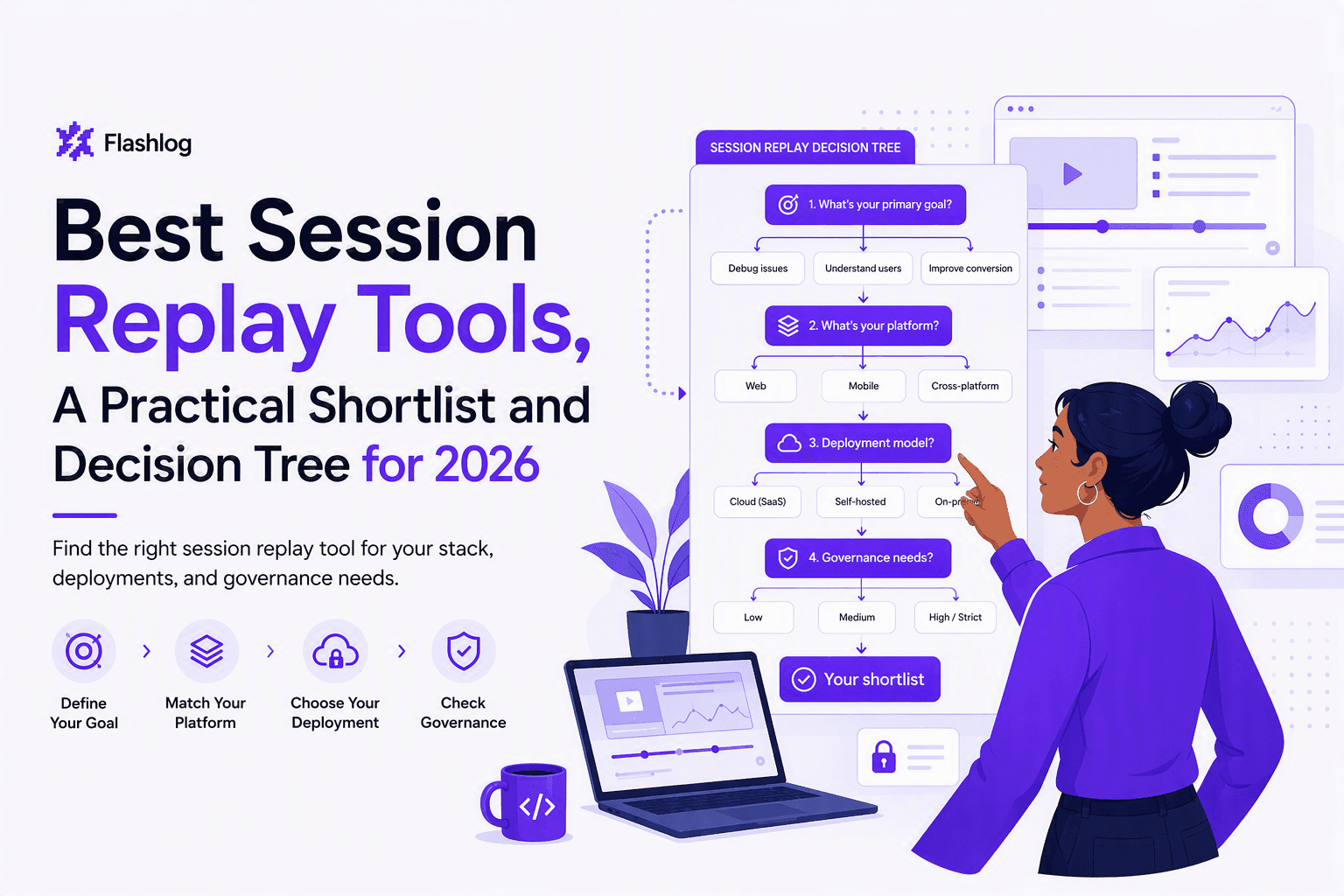
Best Session Replay Tools, A Practical Shortlist and Decision Tree for 2026
A buyer-focused shortlist of best session replay tools for 2026, with a decision tree, selection checklist, cost pitfalls, and a comparison table.

How Session Replay Works, The End-to-End Pipeline From Capture to Playback
Learn how session replay works end to end: capture, serialize, transmit, store, and reconstruct, plus Android specifics, performance, and privacy.