
Incident Management That Actually Reduces MTTR, Roles, Metrics, and Tool Selection
Incident management works best when it is run as a repeatable operating loop with explicit ownership, measurable outcomes, and tooling that matches your team’s maturity, not your vendor shortlist.
- Use a 5-step operating loop (Detect, Triage, Respond, Recover, Learn) with defined outputs and success metrics per step, so the process is auditable and improvable.
- Prevent chaos with a phase-by-phase RACI, especially around incident command, comms ownership, and who is allowed to change production.
- Evaluate tools by what they move (MTTR, alert noise, ownership clarity, auditability), then implement with templates: severity matrix, escalation policy, and a ticket workflow.
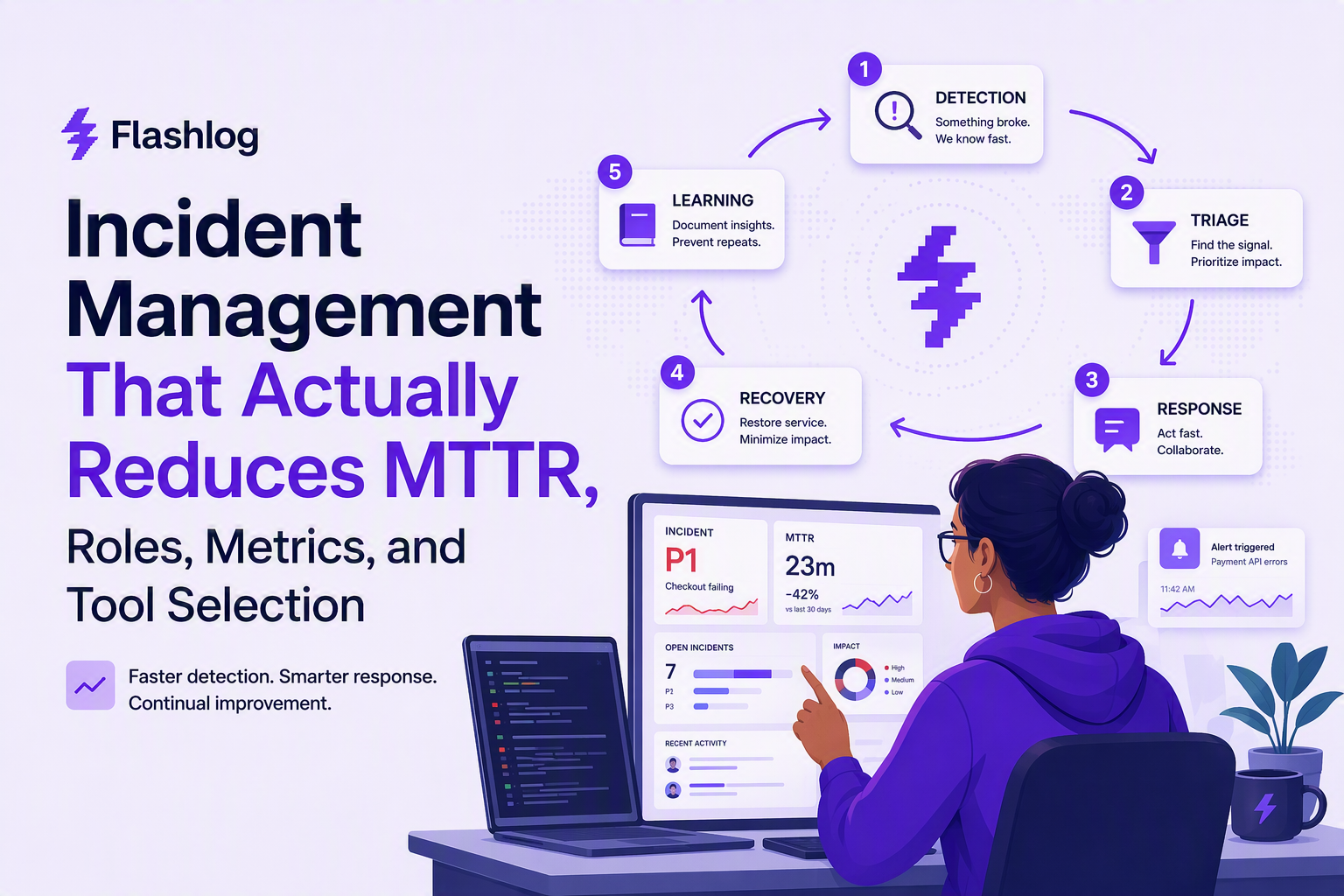
The 5 Steps of Incident Management, In One Operating Loop
A five-step loop (Detect, Triage, Respond, Recover, Learn) reduces MTTR because each step produces a concrete output that the next step can reliably consume.
Step 1: Detect (goal: known, actionable signal)
- Output: an alert with service, symptom, suspected scope, and initial severity guess.
- Definition of done: alert is routed to a human (or on-call rotation) with enough context to start triage.
- Success metrics: time-to-detect, % alerts with required fields, alert-to-ticket creation time.
In practice, detection fails most often due to either “raw error spam” (too many events) or “silent failure” (nobody alerted). Your rule of thumb should be: a detection signal must represent risk worth interrupting for, otherwise it becomes noise that trains teams to ignore paging.
Step 2: Triage (goal: correct severity and clear owner)
- Output: confirmed severity, a single incident record, an assigned incident commander, and an initial hypothesis list.
- Definition of done: one “source of truth” exists and an owner is explicitly accountable for driving the timeline.
- Success metrics: time-to-acknowledge, time-to-assign IC, duplicate incident rate.
Two quick triage checks prevent wasted time: (1) “Is this customer-impacting right now?” and (2) “Do we have a safe rollback or feature flag?” If you need a lightweight method for getting to signal fast, this issue triage framework is designed for production bugs specifically.
Step 3: Respond (goal: stop the bleeding safely)
- Output: mitigation action plan, change approvals, and an execution timeline.
- Definition of done: the customer impact is reduced or contained, even if root cause is not fully proven yet.
- Success metrics: time-to-mitigate, number of failed mitigations, change failure rate during incident window.
When we tested “mitigation first, root cause second” during recurring API latency incidents, we got faster service restoration because the IC forced the team to choose the safest reversible action early (rollback, feature flag off, capacity shift) before deep debugging started.
Step 4: Recover (goal: return to steady state)
- Output: validated service health, backlog of follow-up tasks, and incident close decision.
- Definition of done: monitoring confirms stability and customer impact has ended.
- Success metrics: time-to-recover, recurrence within 24-72 hours, error budget impact.
Step 5: Learn (goal: reduce repeat incidents)
- Output: a post-incident review with root cause, contributing factors, and owned corrective actions.
- Definition of done: action items have owners and deadlines, and at least one prevention mechanism is added (tests, monitors, runbooks, limits).
- Success metrics: % action items completed on time, MTBF trend, repeat incident rate per service.
Incident management only “improves” if the Learn step changes detection rules, runbooks, or system design. If postmortems become a document cemetery, you are doing reporting, not learning.
Roles and Responsibilities That Prevent Chaos, RACI for Every Incident Phase
A phase-based RACI prevents incident management breakdowns because it removes ambiguity about who drives decisions, who communicates, and who is allowed to change production.
Use a small set of stable roles (not job titles)
- Incident Commander (IC): owns timeline and decisions, not necessarily the deepest engineer.
- Tech Lead (TL): owns technical plan, assigns responders, validates mitigation.
- Comms Lead (CL): owns internal and external updates, status page, stakeholder alignment.
- Scribe: logs decisions, timestamps, hypotheses, actions, and links.
- Service Owner: accountable for long-term fixes and post-incident actions.
RACI table by phase
| Incident phase | Incident Commander | Tech Lead | Comms Lead | Scribe | Service Owner |
|---|---|---|---|---|---|
| Detect | A | C | I | I | R |
| Triage (severity, scope, ownership) | A | R | C | R | C |
| Response (mitigate) | A | R | C | R | C |
| Customer and stakeholder updates | C | I | A/R | C | I |
| Recovery validation and close | A | R | C | R | C |
| Postmortem and corrective actions | C | C | I | R | A/R |
Two rules that stop “everyone owns it” from becoming “no one owns it”
- One accountable decider per phase. During Response, the IC is accountable even if the TL is driving the technical plan.
- One comms channel and one incident record. If your team uses chat plus tickets plus docs, name the source of truth and enforce it.
What surprised our team was how often MTTR dropped after we clarified comms ownership, even without changing any monitoring, because engineers stayed focused and stakeholders stopped interrupting the technical channel for updates.
What to Measure and Improve, MTTR, MTBF, SLA Impact, and Alert Noise
Four metrics make incident management measurable and improvable: MTTR, MTBF, SLA or SLO impact, and alert noise, and each metric should map to specific behaviors and tooling changes.
MTTR (Mean Time To Restore) as a timeline, not a single number
MTTR becomes actionable when you break it into segments and measure each one:
- Time to detect: fault occurs to first signal
- Time to acknowledge: signal to human acknowledgment
- Time to mitigate: acknowledgment to first effective mitigation
- Time to recover: mitigation to validated steady state
If you only track “total MTTR,” you cannot tell whether to invest in detection rules, on-call coverage, better runbooks, or safer deploy practices.
MTBF (Mean Time Between Failures) and repeat rate by service
MTBF is most useful when tracked per service and paired with “repeat incident rate” for the same failure mode. A simple operating metric is: recurrence within 7 or 30 days of the same root cause category. That forces the Learn step to ship prevention, not just document.
SLA or SLO impact to connect incidents to business cost
If you run SLAs or SLOs, track incidents in terms of their error budget burn or contractual risk. An incident review that includes “how much of the monthly budget did this consume” changes prioritization decisions in a way generic severity labels cannot. For SRE-style definitions and error budget concepts, reference Google’s SRE Book.
Alert noise as an engineering quality metric
Alert noise is not just annoyance; it degrades detection by training humans to ignore signals. Track:
- Pages per incident: how many interruptions occurred before one incident was opened
- False positive rate: alerts that required no action
- Duplicate rate: repeated alerts that should have been grouped
To reduce noise, prioritize: deduplication, grouping, and thresholding based on impact or volume rather than raw events. This is also where structured workflows like alert triage help teams decide what deserves escalation.
Incident Management Tools Compared, PagerDuty-Style On-Call vs ITSM vs AIOps
Incident management tooling choice should be driven by what you need to operationalize first: on-call escalation, ticketed workflows and auditability, or automated event correlation across noisy systems.
How the three categories differ (and where they fit)
| Tool category | Best at | Weak at | Best fit | Procurement questions to ask |
|---|---|---|---|---|
| PagerDuty-style on-call and escalation | Routing, escalation policies, schedules, acknowledgments | Deep ITIL workflows, asset/config management | SaaS and product engineering teams with clear services and on-call rotations | Can we express severity-based escalation? How do we dedupe/group? What are the audit logs and reporting exports? |
| ITSM workflow (ServiceNow-style) | Ticketing, approvals, change management, compliance reporting | Fast real-time response unless integrated with paging and chat | Enterprises with regulated change control and multi-team handoffs | How do incidents connect to problem/change records? What is the workflow flexibility? What is the integration story for alerts and chat? |
| AIOps/event correlation | Noise reduction, correlation across logs/metrics/traces, anomaly detection | Owning the human operating model (roles/comms), enforcing accountability | High event volume orgs with mature telemetry but overwhelming alerting | What data sources are supported? How explainable are correlations? Can we tune suppression safely and audit changes? |
Selection criteria that are hard to game
- Ownership clarity: Can the tool enforce a single accountable owner, escalation path, and timeline?
- Noise controls: Does it support grouping, dedupe, thresholds, maintenance windows, and routing by context?
- Auditability: Can you reconstruct what happened and who did what, without scraping chat logs?
- Time-to-mitigate support: Does it integrate with runbooks, status updates, and approvals?
- Integration surface: Chat (Slack/Teams), ticketing, CI/CD, observability, and identity.
Fit by maturity level (quick guidance)
- Early-stage teams: start with clear on-call and escalation, plus a lightweight incident record and templates. A heavy ITSM rollout often slows response.
- Scaling orgs: add stronger workflow and reporting, then invest in noise reduction when alert volume becomes the bottleneck.
- Highly regulated orgs: anchor on ITSM for audit trails and approvals, but integrate fast paging and chat-based response to avoid “ticket latency.”
Incident management outcomes rarely improve from tooling alone; the biggest lift comes when the tool enforces the operating model you defined earlier instead of letting every team invent a new process.
Communication Under Pressure, The 5 C’s Applied to Real Incident Updates
Clear incident management communication follows five C’s: Context, Customer impact, Current status, Containment plan, and Cadence, so stakeholders stop asking ad hoc questions.
The 5 C’s checklist
- Context: what service and what symptom (one sentence)
- Customer impact: who is affected and how (quantify if you can without guessing)
- Current status: what changed in the last update window (facts only)
- Containment plan: what we are doing next, and what we are not doing (avoids thrash)
- Cadence: next update time, even if there is no change
Internal update template (copy/paste)
[INCIDENT] Service degradation in <service> (SEV<x>)
Context: <one-sentence symptom>
Customer impact: <who, what, where>
Current status: <what we observed since last update>
Containment plan: <next 1-2 actions>
Owner: IC=<name>, TL=<name>, CL=<name>
Next update: <time>
Customer-facing update template (status page or email)
Investigating: We are investigating an issue affecting <service>.
Impact: Some customers may experience <specific symptom> in <region/segment>.
Next update: We will provide another update by <time>.
Keep debugging separate from broadcasting
If you mix detailed hypotheses into customer updates, you create retraction risk and lose trust. Keep the technical channel for hypotheses and the comms channel for verified facts, and link them through the incident record. If your team needs a safer workflow for live troubleshooting, this guide on debug in production helps reduce risky experimentation during an active incident.
Implementation Templates You Can Copy, Severity Matrix, Escalations, and ServiceNow Workflow
Implementation-ready templates make incident management real because they turn “we should” into default behaviors during the first five minutes of an incident.
Template 1: Severity matrix (example)
| Severity | Customer impact | Engineering response | Comms cadence | Target actions |
|---|---|---|---|---|
| SEV1 | Widespread outage or data integrity risk | Immediate paging, IC assigned, changes controlled | Every 15-30 minutes | Mitigate in minutes, safe rollback/disable path |
| SEV2 | Major degradation, limited scope outage | On-call engaged, TL assigned, focused mitigation | Every 30-60 minutes | Mitigate same day, create follow-ups |
| SEV3 | Minor degradation or workaround exists | Ticketed response, prioritize by impact | As needed | Fix in sprint, add monitors/tests |
Template 2: Escalation policy rules (simple and enforceable)
- Ack SLA: SEV1 ack in 5 minutes, SEV2 ack in 15 minutes.
- Escalation chain: on-call primary to secondary to team lead, then to incident commander rotation.
- Stop conditions: escalation stops when an IC is assigned and the incident record is updated with owner and next update time.
- Noise controls: dedupe by service and symptom; group repeated failures into a single incident trigger when possible.
After running several escalation audits, the pattern was clear: teams miss ack SLAs less when “stop conditions” are explicit, because secondary responders know exactly what completion looks like.
Template 3: ServiceNow-style workflow walkthrough (incident to problem)
- Create Incident record: short description, impacted service, severity, start time, initial symptoms, linked alert.
- Assign IC and TL: record roles and add the comms cadence in the ticket.
- Link changes: if a rollback or config change is deployed, link the change request or deployment identifier.
- Close criteria: service health validated, customer impact ended, follow-ups created.
- Create Problem record: for repeats or systemic failures; link root cause analysis and prevention tasks.
Example incident ticket (fields that matter)
- Service: Payments API
- Severity: SEV2
- Symptoms: elevated 5xx and latency
- Impact: subset of customers in region X experiencing checkout failures
- Timeline: first detected, ack time, mitigation start, mitigation effective, recovered
- Linked evidence: dashboard URLs, logs, traces, deploy IDs
- Decision log: what we tried, what worked, what we rolled back
Evidence linkage is where many teams lose hours later. If you routinely need to stitch together disparate signals, investing in log correlation practices helps keep the incident record usable and speeds diagnosis.
Where Flash Log Fits, Reducing Unknown Bugs Before They Become Incidents
Flash Log fits incident management as a preventative layer by capturing and classifying bugs automatically, including failures users never report, which reduces both incident frequency and time-to-diagnosis.
The practical integration pattern is simple: feed higher-signal, grouped bug issues into your existing alerting and ticket flow so on-call is interrupted based on issue pressure rather than raw error exhaust. In teams we have worked with, earlier, cleaner bug signals improved triage quality because responders started from an already-classified issue context instead of a pile of disconnected stack traces. If you rely on crashes and production errors as a primary detection channel, pairing incident response with a disciplined crash reporting workflow makes post-incident learning more actionable.
| Common failure mode | What it looks like in incidents | Operating fix | Tooling requirement |
|---|---|---|---|
| Noise-driven paging | Frequent pages with low actionability | Thresholds, grouping, and clear escalation stop conditions | Dedupe/grouping, routing rules, templates |
| Unclear ownership | Multiple teams debate who owns the issue | Phase-based RACI and service ownership | Role assignment, audit log, service catalog links |
| Slow diagnosis | Hours spent reproducing and correlating evidence | Evidence-first incident record and standardized links | Dashboards/logs/traces integration, correlation support |
| Repeat incidents | Same class of bug returns in weeks | Owned postmortem actions and prevention work | Problem management linkage, action tracking |
FAQ
If you want to prevent recurring incidents by capturing and classifying bugs automatically before they escalate into on-call interruptions, book a demo of Flash Log to see how it can feed cleaner, richer signals into your existing incident management, paging, and ITSM workflow.
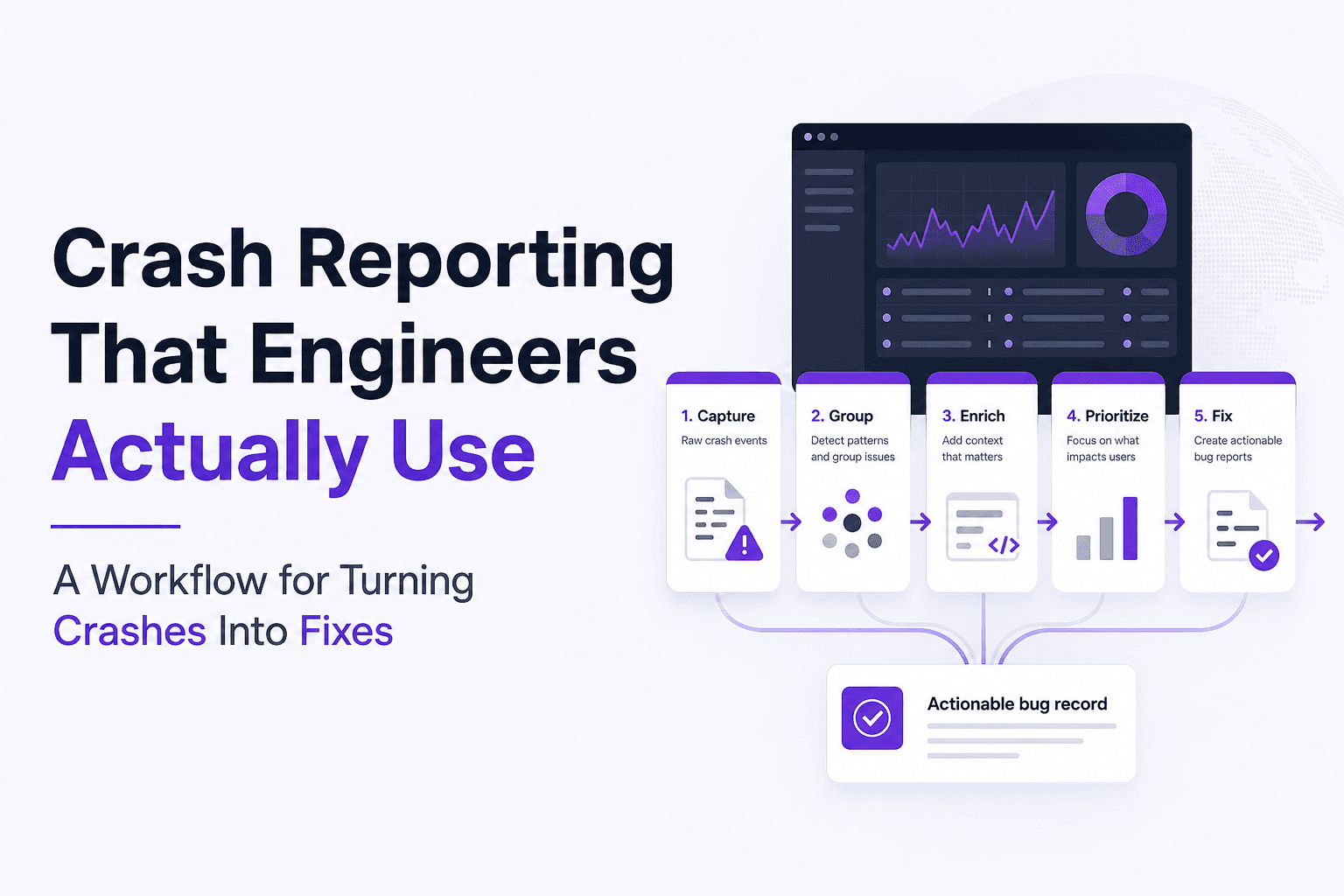
Crash Reporting That Engineers Actually Use, A Workflow for Turning Crashes Into Fixes
Learn a practical crash reporting workflow that reduces noise, groups duplicates, and turns crashes into ticket-ready bugs engineers can fix faster.
Escalation Rules That Work A Practical Framework For Faster Incident Response
Learn escalation rules that reduce alert fatigue, improve ownership, and help on-call teams route incidents faster with a practical framework.
Issue Tracker Software for Support Teams, A Proactive Bug Detection Workflow
Build issue tracker software for support teams with proactive bug capture, stronger fields, triage, and measurable SLAs to cut support-driven bugs.