
AI Alerting That Cuts Noise, A Practical Setup Playbook for SRE and DevOps Teams
AI alerting is the practice of using machine learning and automated classification to reduce noisy pages and surface only actionable incidents, without losing real production signals. The most effective setups treat “AI” as a decision layer across the alert lifecycle: detect, deduplicate, suppress, route, enrich, and learn from outcomes so alert quality improves week over week.
- Design ai alerting as a pipeline with explicit gates (signal definition, baselines, noise controls, routing, and runbooks), not as a single “smart threshold.”
- Measure alert quality using operational proxies: alert precision (actionable rate), pages per on-call shift, and time-to-mitigate, then iterate weekly.
- Combine deterministic controls (ignore rules, dedup fingerprints, suppression windows) with AI classification to keep the backlog and chat alerts trustworthy.
AI alerting meaning and scope for SRE and DevOps teams
AI alerting works best when you separate three jobs: detection (spot abnormal behavior), triage (decide if it is actionable), and consumer alerts (who gets notified and how). If you blur these, you usually end up tuning thresholds forever while still paging on expected failures and duplicate storms.
Detection vs triage vs consumer alerts
- Detection: turns telemetry into candidate incidents (metric anomalies, error-rate thresholds, SLO burn alerts).
- Triage: reduces noise by classifying candidates (expected vs unexpected, duplicate vs new, low confidence vs high confidence).
- Consumer alerts: routes the remaining items into pages, tickets, or chat notifications with the right urgency.
A quick decision tree to avoid “AI everywhere”
- Is this about waking someone up? If yes, prefer deterministic SLO/burn-rate detection plus strict triage gates.
- Is this about backlog quality? Use classification and dedup aggressively; time sensitivity is lower.
- Is this about root-cause hints? Add enrichment (top endpoints, recent deploys, correlated logs) rather than changing page criteria.
In our experience working with on-call teams, the fastest wins come from using AI for triage first, because it directly reduces repeated pages and “known business errors” that engineers never fix.
A practical AI alerting workflow from signals to actionable pages
A workable ai alerting pipeline has five explicit stages: candidate generation, normalization, noise gates, routing, and learning loops. You can implement this with your existing monitoring stack by adding a small set of rules and outcomes tracking.
The end-to-end pipeline (5 stages)
- Generate candidates: SLO burn alerts, error-rate alerts, latency alerts, and “symptom” alerts from logs.
- Normalize and label: standard fields (service, endpoint, environment, severity, customer impact, deploy version).
- Apply noise gates: ignore rules, dedup, suppression windows, minimum-activity gates, and confidence gates.
- Route and notify: map to owners, escalation rules, and destination (page vs ticket vs digest).
- Learn from outcomes: mark alerts as actionable/non-actionable and adjust gates weekly.
Worked example: SaaS checkout failure from page to resolution
Scenario: A SaaS app sees a spike in failed checkout requests. Telemetry emits (a) elevated HTTP 500s on POST /api/checkout and (b) increased “payment declined” responses.
- Candidate A (500s): qualifies for paging if it breaches an SLO burn threshold (for example, a fast-burn window plus a slow-burn window) and impacts completion.
- Candidate B (payment declined): expected business response, should be muted or downgraded unless it spikes beyond a fraud/processor health threshold owned by a different team.
Sample triage decisions (what passes the gate)
- Ignore rule: If status=402 and reason=card_issuer_declined, do not page engineering; send to a dashboard or weekly report.
- Dedup fingerprint: Group identical stack traces or identical endpoint+error code combinations into one issue with an occurrence count.
- Confidence gate: If context is missing (no user journey, no correlation ID, no stack), hold as “needs more data” instead of paging.
To keep the process concrete, define the “output contract” for every alert as fields you can route on: {service, environment, severity, fingerprint, decision, confidence, owner, next_action}.
AI noise reduction techniques that actually work in production
Noise reduction in ai alerting is mostly about preventing duplicate and expected events from turning into interruptions, using a small set of predictable controls. The techniques below are implementation patterns you can apply even without changing your monitoring vendor.
1) Dedup by fingerprint, not by title
Dedup should group events that share a root cause even when metadata varies (different users, different pods). Practical fingerprints include:
- Backend: exception type + top stack frames + route template
- HTTP: method + normalized route + status class + error code
- Frontend: error message + component + build version
Rule of thumb: if a human would say “same bug,” it should be one issue with an occurrence counter, not 50 pages.
2) Suppression windows for known storms
Use short suppression windows when a single root cause creates many alerts. Example pattern:
if fingerprint matches existing_open_issue then
  suppress_pages_for = 30m
  increment_occurrence_count
  notify_once_per = 30m (chat digest)
end
What surprised our team was how often a 10 to 30 minute suppression window reduced pages without delaying mitigation, because the first page already triggered the right response.
3) Minimum-activity gates to avoid “one-off” pages
A minimum-activity gate prevents paging on a single failure when traffic is low or sampling is partial:
- Absolute gate: page only if failures >= N in 5 minutes.
- Relative gate: page only if error rate >= X% and request volume >= V.
This is especially important for background jobs and rarely used endpoints.
4) Severity tuning tied to user impact
Severity should map to impact, not to “how red the graph looks.” A simple rubric:
- SEV1 page: blocks core user journey (login, checkout) and is widespread.
- SEV2 ticket: partial degradation or limited segment impact.
- SEV3 digest: flaky, intermittent, or low-confidence signals.
For deeper operational structures, pair these gates with an alert management framework so suppression and routing are governed the same way.
How to configure baselines and thresholds without creating new noise
Baselines reduce false alarms only when you control seasonality, sensitivity, and “unknown unknowns” like deploys and traffic shifts. The goal is not perfect prediction; it is stable alert behavior under normal variance.
Choose the baseline type based on traffic shape
- Static threshold: best for hard limits (queue depth max, disk usage).
- Rolling baseline: compares against recent history; good for gradual drift.
- Seasonal baseline: compares to same hour/day; best for strong daily patterns.
Guardrails that keep baselines sane
alert "checkout_error_rate_anomaly" {
  signal: error_rate("POST /api/checkout")
  baseline: seasonal(lookback=14d)
  sensitivity: medium
  min_volume: 200 req / 5m
  deploy_guard: if deploy_in_last(30m) then require 2x confidence
  decision: page if burn_rate_fast AND burn_rate_slow
}- Min volume prevents low-traffic alerts.
- Deploy guard reduces “new version” churn by requiring stronger evidence right after a rollout.
- Two-window confirmation (fast + slow) prevents one noisy spike from paging.
If you are actively battling storm conditions, align baseline alerts with your alert storm response so anomaly detection does not amplify the blast radius.
Alert routing, RCA hints, and runbooks that reduce MTTR
Routing reduces time-to-mitigate only when every page carries enough context to choose a next action within minutes. Treat routing as a deterministic mapping from labels to owners and runbooks, then use AI for enrichment and suggested suspects.
Routing rules: page less, route better
route {
  if service="checkout" and severity in ["SEV1","SEV2"] then
    page team="payments-oncall"
  else if service="checkout" and severity="SEV3" then
    create_ticket queue="payments"
  else
    send_digest channel="#ops-review"
}
Keep routing logic small and auditable; complexity belongs in the triage gate, not in notification sprawl. If your org needs explicit escalation steps, define and publish an escalation policy so after-hours decisions are consistent.
RCA hints: what to attach to every actionable alert
- Recent deploys: version, deploy time, commit range
- Top offenders: endpoint, tenant, region, pod, error class
- Correlations: spike in latency, DB errors, dependency timeouts
- Links: dashboards, logs (pre-filtered), traces for a sampled exemplar
Runbooks: triggers and “first 10 minutes” steps
- Trigger: fingerprint or SLO name maps to a runbook section.
- Steps: verify impact, check deploy, rollback criteria, mitigation toggles, owner escalation.
After running a few routing audits, the pattern was clear: the biggest MTTR drops came from adding one field engineers trusted (a stable fingerprint) plus a single “next action” link, not from adding more charts.
For teams formalizing this operationally, the companion practice of alert triage keeps ownership, suppression, and severity consistent across services.
How to evaluate AI alerting quality in 2 weeks
A 2-week evaluation of ai alerting should focus on precision, page volume, and time-to-mitigate, using simple labels and a lightweight review loop. You do not need perfect recall measurement to see whether noise is going down and outcomes are improving.
Week 1: instrument outcomes and define “actionable”
- Add an outcome label to each page/ticket: actionable, duplicate, expected, low-context, false-positive.
- Define actionable in one sentence: “An alert is actionable if an engineer took a mitigation step or opened a work item within 30 minutes.”
- Track pages per on-call shift (or per day) as your core fatigue metric.
Week 2: calculate proxies and apply one improvement per gate
- Precision proxy: actionable / total pages (trend it, do not overfit).
- Duplicate rate: duplicates / total pages (drives dedup work).
- “No-context” rate: alerts missing required fields (drives enrichment work).
- MTTR trend: compare before/after for similar incident types.
If precision is low, fix gates in this order: (1) ignore expected business errors, (2) dedup fingerprints, (3) suppression windows, (4) baseline sensitivity. This sequence tends to reduce pages without hiding real incidents.
A lightweight review checklist (30 minutes, weekly)
- Top 5 noisy fingerprints: add dedup or suppression.
- Top 3 expected errors that paged: add ignore rules or downgrade.
- Top 3 longest mitigations: add runbook triggers and enrichment.
For broader patterns and implementation guidance, align these controls with an ai noise reduction framework so you can explain, audit, and adjust the decisions over time.
| Alert lifecycle stage | Common noise failure mode | Control to apply | What to measure weekly |
|---|---|---|---|
| Candidate generation | Too many symptom alerts | SLO burn alerts for paging; keep symptoms for dashboards | Pages/day; incidents caught by SLO vs symptoms |
| Normalization | Missing service/owner labels | Required fields contract for alerts | No-context rate |
| Noise gates | Duplicates and expected errors page | Fingerprint dedup, ignore rules, suppression windows | Duplicate rate; actionable rate |
| Routing | Wrong team gets paged | Owner mapping + escalation matrix | Reassignments; time-to-ack |
| Runbooks/enrichment | Slow triage due to missing context | RCA hints + runbook triggers | MTTR trend for repeat incident types |
FAQ
If you want to complement your ai alerting pipeline with cleaner, higher-confidence bug signals, consider piloting Flash Log as a capture-and-classify layer: it automatically captures and classifies bugs (including when users do not report them) so engineers spend less time triaging noisy events and more time fixing the issues that actually impact customers.
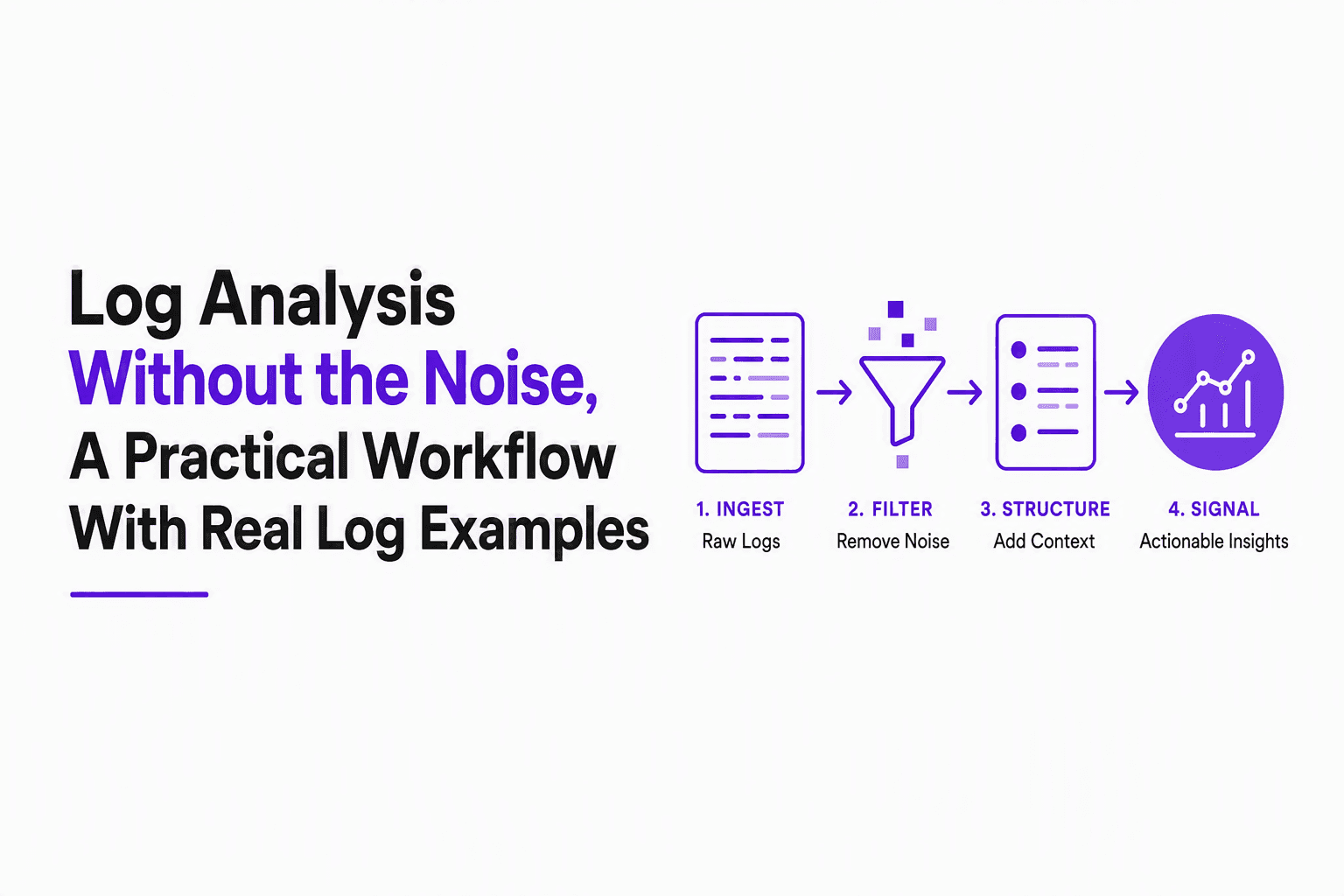
Log Analysis Without the Noise, A Practical Workflow With Real Log Examples
Learn log analysis without alert fatigue: a repeatable workflow, real log examples, Linux commands, and AI noise reduction guardrails.
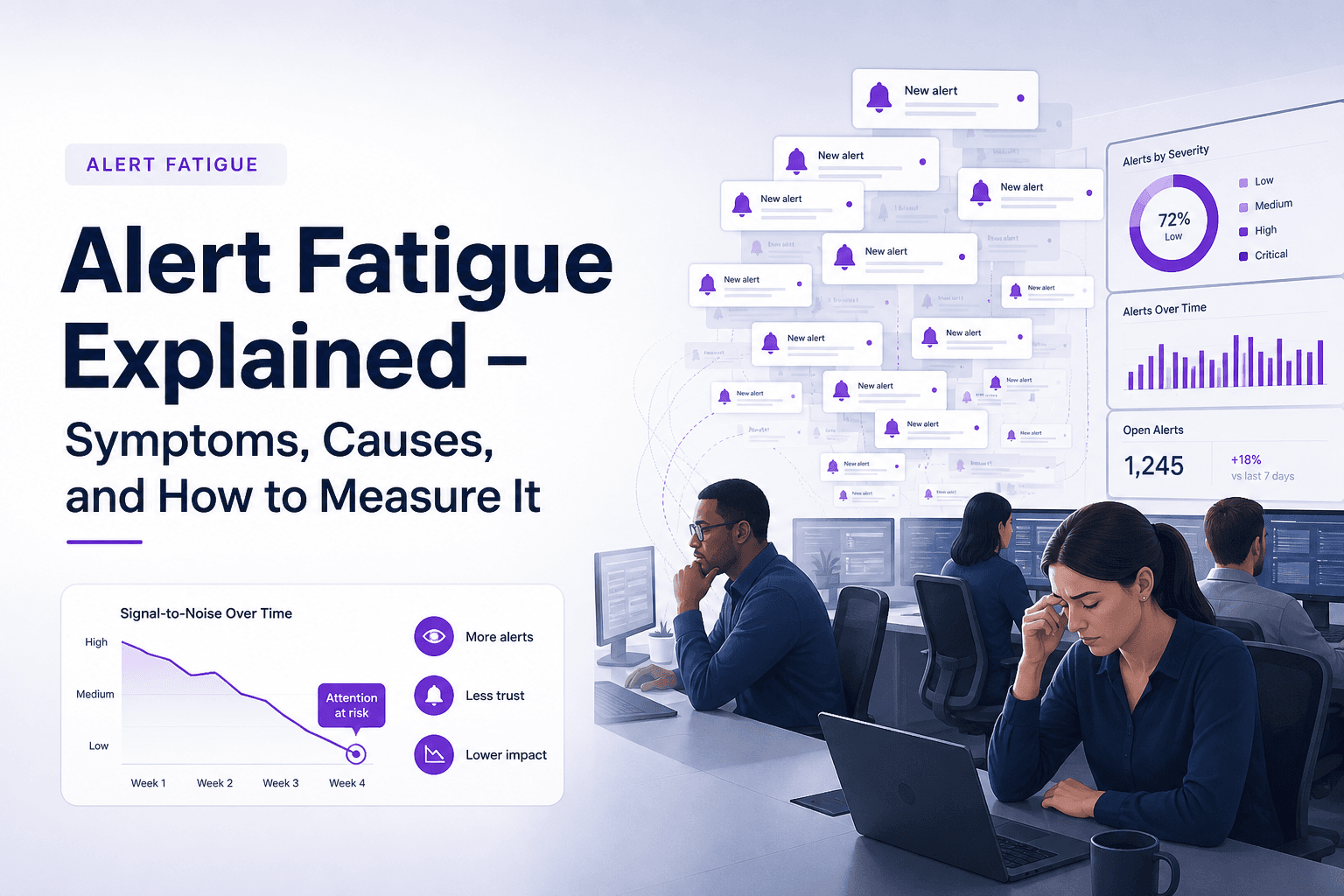
Alert Fatigue Explained - Symptoms, Causes, and How to Measure It
Learn what alert fatigue is, the symptoms to watch for, the main causes, and how to measure alert fatigue before incidents are missed.
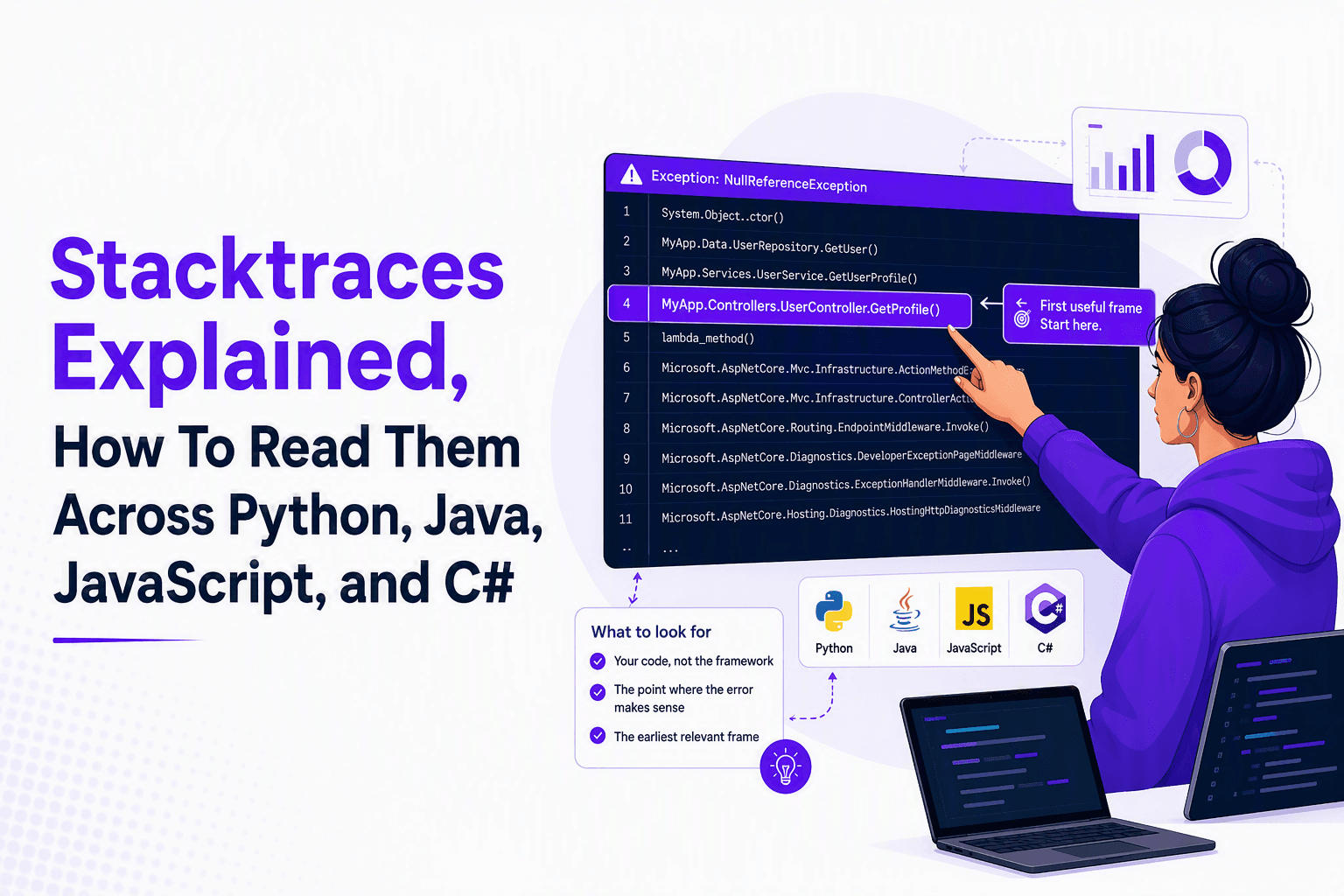
Stacktraces Explained, How To Read Them Across Python, Java, JavaScript, and C#
Learn how to read stacktraces fast: find the useful frame, reduce noise, handle missing symbols, and share redacted traces safely.